
Blog
Transforming Corporate Finance: Beyond the Basics of Connected Planning
Introduction to Enhanced Corporate Finance Solutions
The evolution of corporate finance has introduced concepts like 'connected financial close,' 'connected planning,' and 'connected reporting.' These terms reflect the integration of essential financial processes such as financial close and consolidation, account reconciliation, financial reporting, and extended planning and analysis (XP&A). The appeal of these connected systems is clear: they promise to unify teams by linking them directly with data and financial plans, thereby driving speed and agility.
Exploring Connected Finance Solutions
For over two decades, connected planning solutions have been instrumental in driving finance transformation. However, these systems are not always well-suited for large, complex organizations aiming to lead swiftly in today’s dynamic environment. It's crucial for finance teams to advance beyond traditional connected planning. Today's discussion focuses on preparing finance teams for this necessary shift.
The Limitations of Current Connected Planning Approaches
While modern connected planning systems offer a viable alternative to outdated, manual processes for smaller or less complex entities, they often fall short in large, global organizations with intricate needs that span the entire Office of Finance and extend into various business lines. Scaling these connected solutions to meet the demands of such diverse and sophisticated environments poses significant challenges. Integrating every departmental and corporate application adds layers of risk, cost, and complexity that can overwhelm finance teams.
Moreover, these systems typically require fragmented software, which complicates the support of crucial financial processes like financial data quality and diverse planning tasks (e.g., S&OP, sales planning). This fragmentation can increase risks, costs, and complexities across the Office of Finance.
Data Management and Lack of Financial Intelligence
The need for disparate software and technical processes in supporting comprehensive corporate performance management (CPM) tasks leads to increased technical complexity and administrative burdens. Finance teams must manage and reconcile data, oversee metadata, monitor latency, and ensure security across disjointed products or models. These challenges detract from their ability to drive performance and aid in crucial decision-making.
Additionally, many connected finance solutions lack embedded financial intelligence, meaning that fundamental financial logic—such as account types, timelines, hierarchies, dimensionality, and currency translation—must be developed from scratch.
Reevaluating Solutions: The Need for a Unified Platform
Some organizations start their journey with multiple-point solutions, hoping to achieve connectivity, only to reconsider their approach after a few years due to the lack of standardization. This can be particularly problematic in rapidly growing companies, where a unified organizational view becomes crucial.
Rather than seeking further integrations, which may exacerbate the issue, organizations should consider a truly unified platform for all performance management processes. OneStream offers such a platform, designed to transcend the limitations of traditional tools by integrating financial consolidation, planning, reporting, and analysis into a single, extensible solution.
OneStream's Unified Solution
OneStream's platform not only adheres to corporate standards but also allows business units the flexibility to operate with more detailed reporting and planning. This unified approach avoids the pitfalls of integration and ensures that all processes—actuals, budgets, forecasts, plans, reconciliations, and profitability analysis—coexist harmoniously within a single application. This integration enhances overall functionality and reduces the risk associated with using multiple disparate systems.
By adopting a unified platform like OneStream, organizations can eliminate the need for risky integrations and simplify their financial operations, paving the way for more strategic and effective finance management.
Contact MindStream Analytics

Want to learn more about OneStream Software? Please complete the form below and we'll get back to you shortly.
Featured Webinar
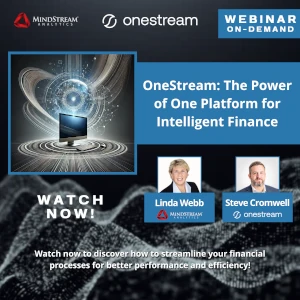
Join us for a compelling webinar as we delve into the revolutionary capabilities of OneStream Software for corporate performance management (CPM).
OneStream: The Power of One Platform for Intelligence Finance
Partner SpotLight

OneStream CPM
OneStream aligns to your business needs and changes more quickly and easily than any other product by offering one platform and one model for all financial CPM solutions. OneStream employs Guided Workflows, validations and flexible mapping to deliver data quality confidence for all collections and analysis while reducing risk throughout the entire auditable financial process.