Identify potential gaps in your intercompany reconciliation process, from transaction matching and data integration to exception management and financial controls.
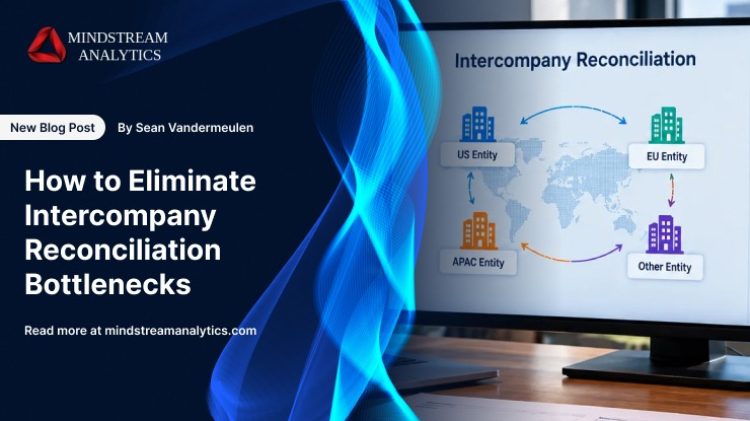
Imagine this: The consolidation deadline is just hours away, but several subsidiaries still report mismatched intercompany balances. Missing invoices, inconsistent exchange rates, and delayed postings have left the finance team chasing discrepancies instead of finalizing the books, putting additional pressure on an already time-sensitive close.
For finance leaders managing multiple entities, this is more than a month-end challenge. As organizations expand across geographies, business units, and ERP platforms, differences in transaction references, intercompany accounting policies, posting schedules, and data formats make intercompany reconciliation increasingly complex.
Disconnected systems and unclear ownership can prolong investigations, increase manual follow-ups, and allow unresolved discrepancies to carry into subsequent reporting periods. Over time, these recurring intercompany reconciliation bottlenecks can limit visibility into outstanding balances, complicate close planning, and leave finance teams with less time for analysis and decision-making.
Intercompany reconciliation can become a bottleneck when intercompany accounting processes rely on inconsistent records, disconnected ERP systems, and manual exception handling. These challenges make it harder for finance teams to resolve mismatches promptly, maintain visibility into outstanding balances, and complete the financial close on schedule.
Addressing these bottlenecks requires more than adding resources during close. Finance teams need a standardized, integrated, automated, and well-governed approach to identify discrepancies earlier, resolve them efficiently, and support a more predictable consolidation process. A coordinated approach to intercompany accounting can help finance teams address these challenges before they escalate during close.
This guide explores six practical steps to improve reconciliation, resolve discrepancies earlier, and support a more predictable financial close.
- Standardize intercompany accounting policies and cut-off dates
- Move from month-end intercompany reconciliation to continuous matching
- Automate intercompany transaction matching
- Integrate financial data across ERP systems
- Establish centralized visibility into intercompany reconciliation exceptions
- Strengthen governance, documentation, and accounting controls
Step 1: Standardize Intercompany Accounting Policies and Cut-Off Dates

What It Is
Inconsistent intercompany accounting practices can create reconciliation differences before matching even begins. When subsidiaries use different transaction classifications, counterparty codes, account mappings, or posting timelines, corresponding records may not align. Standardizing these practices gives entities a common foundation for intercompany accounting and reconciliation while accommodating applicable local requirements.
Standardization means establishing group-wide rules for recording, classifying, valuing, and reporting transactions between related entities. These rules should cover recurring transactions such as management fees, royalties, inventory transfers, shared services, and intercompany loans.
A consistent policy defines how transactions are identified, which general ledger accounts are used, what supporting documentation is required, and how values are calculated. For example, entities may need an agreed source for foreign exchange rates, consistent transfer pricing parameters, and clearly defined markups.
Cut-off dates are equally important. If one entity records a transaction in the current period and its counterparty records it in the next, the resulting timing difference can complicate intercompany reconciliation and consolidation.
Group-wide policies should not override local statutory or regulatory requirements. Instead, central finance teams should establish common principles and document where local accounting treatments require specific variations.
How It Works
- Map existing practices: Identify differences in transaction classifications, account mappings, counterparty codes, posting procedures, and supporting documentation across entities.
- Define group-wide policies: Establish compatible intercompany accounting treatments, transaction references, currency rules, and documentation requirements for each transaction type.
- Align reporting deadlines: Set common cut-off dates, submission schedules, and approval timelines that support the consolidated close calendar.
- Assign policy ownership: Designate central finance and local entity representatives to communicate intercompany accounting requirements, oversee policy adoption, and resolve related exceptions.
- Configure system controls: Apply standardized templates, required fields, validation rules, and transaction attributes across relevant finance systems.
Why It Matters
Standardized intercompany accounting reduces avoidable differences caused by inconsistent recording practices, incompatible account mappings, and misaligned posting periods. It also makes discrepancies easier to identify because teams are working from compatible definitions and expectations.
For finance leaders, this can mean fewer preventable exceptions, less time spent clarifying transaction details, and more consistent balances across entities. Standardized intercompany accounting processes can also support the onboarding of newly acquired businesses by providing a defined framework for adopting group-wide practices.
However, a policy is only effective when both counterparties apply it consistently. Therefore, central finance should monitor adoption, clarify exceptions, and ensure that local entity teams understand how their responsibilities fit into the wider reconciliation process.
How does transfer pricing affect intercompany reconciliation?
Transfer pricing determines the prices charged for transactions between related entities, such as shared services, inventory, and intellectual property. When counterparties apply inconsistent pricing methods, markups, or terms, their recorded amounts may differ, creating reconciliation discrepancies and potential tax documentation concerns.
Step 2: Move From Month-End to Continuous Intercompany Reconciliation
What It Is
Waiting until the end of the reporting period to identify differences can leave finance teams with limited time to investigate them. Transaction details may be harder to retrieve, responsible employees may be occupied with other close activities, and unresolved items can accumulate. Continuous intercompany reconciliation helps distribute this work throughout the reporting period. This approach allows intercompany accounting teams to distribute reconciliation activities more evenly instead of concentrating investigations at period-end.
Continuous reconciliation involves matching and reviewing intercompany transactions at regular intervals rather than relying exclusively on a month-end exercise. Depending on transaction volume, materiality, and risk, teams may reconcile selected accounts daily, weekly, or fortnightly.
This approach to intercompany accounting and reconciliation includes frequent transaction matching, recurring review cycles, and early investigation of discrepancies. It does not eliminate formal period-end reconciliation or certification. Instead, it helps ensure that fewer unresolved differences remain when the close begins.
How It Works
- Segment reconciliation accounts: Classify accounts by transaction volume, financial materiality, historical discrepancies, and reporting risk to determine where frequent reviews are most useful.
- Set reconciliation frequency: Schedule daily, weekly, or fortnightly matching cycles based on transaction activity, operational needs, and the close calendar.
- Compare transactions regularly: Review corresponding receivables, payables, invoices, and journal entries as transaction data becomes available.
- Investigate discrepancies early: Identify timing differences, missing entries, currency variances, and incorrect postings while supporting information is still accessible.
- Track unresolved items: Assign differences to the relevant entity accountants, set resolution deadlines, and review outstanding items before the close.
Why It Matters
Recurring intercompany reconciliation helps prevent work from accumulating at month-end. Instead of investigating a large backlog under deadline pressure, finance teams can address discrepancies in smaller batches and involve the appropriate entity representatives while transaction context is still available. It also gives intercompany accounting teams more opportunities to resolve timing differences while transaction details are still readily available.
This can improve close predictability, support earlier issue detection, and reduce the number of unresolved items carried into subsequent reporting periods through more consistent intercompany reconciliation. It also helps controllers understand whether recurring discrepancies are isolated incidents or signs of an upstream process issue.
Continuous matching should be designed around business needs, rather than applied uniformly to every account. High-volume or high-risk accounts may warrant more frequent review, while lower-risk accounts may require less frequent cycles. Formal period-end review remains important for confirming completeness, reviewing adjustments, and certifying balances.
Step 3: Automate Intercompany Transaction Matching
What It Is
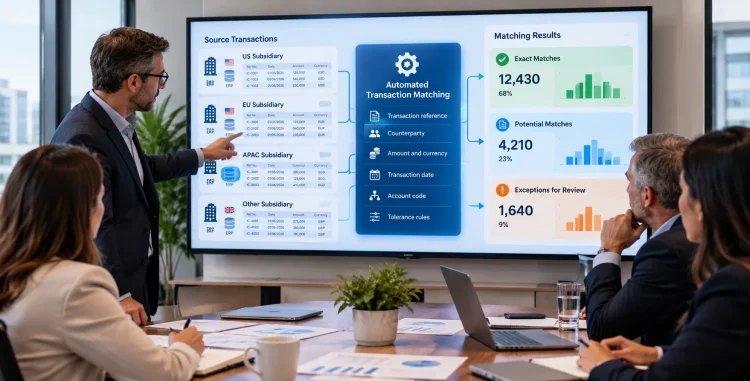
Manual matching can consume significant intercompany accounting time, particularly when teams compare large volumes of transactions across multiple entities and systems. Automated intercompany reconciliation uses predefined rules to identify corresponding records, clear valid matches, and direct unresolved differences for review.
Automated transaction matching uses transaction attributes and defined criteria to compare records from counterparties. Depending on the quality and structure of the source data, matching may be based on exact identifiers, combinations of fields, or approved tolerance thresholds.
Exact matching identifies records with identical relevant attributes. Rule-based matching applies agreed criteria, such as counterparty, amount, currency, transaction reference, or date. Tolerance-based matching may identify potential matches where small differences fall within approved limits. Exception-based processing routes unmatched or uncertain items to people for investigation.
Automation should distinguish between a valid match and a potential match. A transaction should not be cleared simply because it falls within a tolerance if the underlying difference has not been assessed according to policy.
How It Works
- Identify matching attributes: Determine the transaction identifiers, counterparties, amounts, currencies, dates, and account codes relevant to each transaction type.
- Prioritize automation opportunities: Start with high-volume, repetitive, or high-risk transactions where standardized data can support reliable matching and reduce manual effort.
- Configure and test matching rules: Establish exact and rule-based criteria, with tolerance thresholds aligned to intercompany accounting policies, materiality, and risk. Test these rules against representative transaction data before deployment.
- Run automated matching: Compare corresponding records at scheduled intervals, identify exact, partial, and potential matches, and route unmatched or uncertain transactions to the appropriate teams for investigation.
- Monitor and refine performance: Review match rates, false matches, unresolved exceptions, and recurring differences to help intercompany accounting teams refine matching logic and expand automation to additional transaction types when appropriate.
Real-World Example
SourceCode worked with MindStream Analytics to configure OneStream to automatically eliminate intercompany transactions during consolidation. This helped reduce manual consolidation work and supported a more scalable financial reporting process. While intercompany elimination is distinct from automated transaction matching, the case illustrates how OneStream can automate a related intercompany accounting activity within the consolidation workflow.
Read SourceCode’s Case Study Here
Why It Matters
Automation reduces repetitive transaction-level comparisons and allows intercompany accounting teams to focus on exceptions that require judgment. By prioritizing high-volume and standardized transactions, finance teams can introduce automation in manageable phases, validate matching accuracy, and expand its use as data quality and process reliability improve.
Automated matching can help identify unmatched records earlier, particularly when it runs as part of a recurring intercompany reconciliation cycle. Monitoring match rates, exception volumes, false matches, and manual effort can help finance leaders assess whether intercompany accounting automation is improving efficiency without compromising accuracy.
However, automation does not remove the need for intercompany accounting oversight. Matching rules must be tested against representative transaction data, tolerance thresholds should be reviewed carefully, and material or uncertain differences should remain subject to appropriate human review and approval.
Step 4: Integrate Financial Data to Improve Intercompany Accounting
What It Is
Disconnected ERP systems and financial applications can make it difficult to obtain a consistent view of intercompany transactions. When accountants manually extract records, reformat spreadsheets, and combine files from different entities, the process introduces additional effort and opportunities for error. Integrating relevant financial data helps establish a more consistent foundation for intercompany reconciliation, matching, and validation.
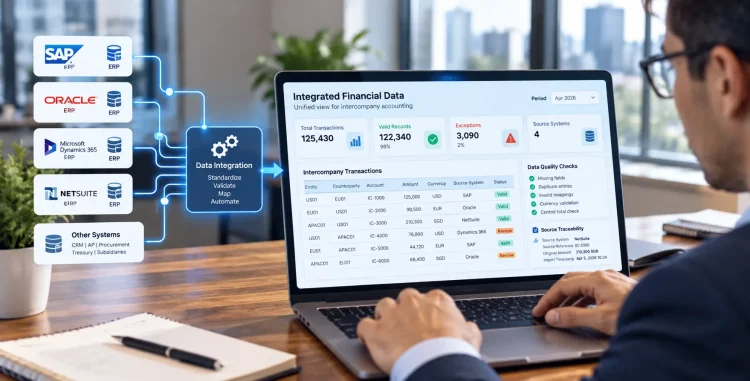
Financial data integration connects relevant transaction records from multiple ERP systems and financial applications into a consistent, governed environment. It allows finance teams to access standardized information across legal entities while retaining traceability to the original source systems.
Integration does not necessarily require an organization to replace its existing ERPs. Different platforms may continue to support local operations, while relevant financial information is transferred through suitable integration methods into a centralized finance or reconciliation environment.
The process depends on common data definitions, standardized mappings, automated imports, validation checks, and source-level lineage. Without these foundations, centralizing data may simply move inconsistencies into another system.
How It Works
- Assess source systems: Map ERP platforms, transactional applications, legal entities, and the specific financial data required for intercompany reconciliation.
- Standardize data structures: Align intercompany accounting identifiers, counterparty codes, account mappings, transaction references, currency formats, and reporting attributes.
- Connect financial systems: Integrate relevant ERP and transactional data into a centralized finance platform using methods suited to the organization’s technology environment.
- Validate incoming records: Apply data-quality checks to identify missing fields, duplicate entries, invalid mappings, and incomplete transactions before matching.
- Maintain data traceability: Preserve source references and reconcile imported totals against source-system control totals to support investigation and audit requirements.
Real-World Example
Urban Grid partnered with MindStream Analytics to integrate its NetSuite ERP with OneStream using an API-based saved-search approach. The integration supported financial data flows and automated updates, including the addition of new dimension members. This example illustrates how connecting ERP and consolidation environments can support more consistent data movement and reporting across finance workflows.
Read Urban Grid’s Case Study Here
Why It Matters
Integrated financial data reduces the need for manual extraction, spreadsheet consolidation, and repeated formatting across entities. It can give intercompany accounting teams more consistent transaction information for matching, validation, and reconciliation while helping them trace differences back to their originating records.
For organizations operating across multiple ERP platforms, integration can also support centralized visibility without forcing a single system to replace every local application. This can be especially relevant as businesses acquire new entities, expand into additional markets, or introduce new financial systems.
However, integration alone cannot resolve poor data quality or inconsistent intercompany accounting practices. Common definitions, validation rules, and clear ownership remain necessary to ensure that the information entering the intercompany reconciliation process is complete, comparable, and reliable.
What information is needed for intercompany reconciliation?
Intercompany reconciliation typically requires transaction-level data from both entities, including invoices, receivables, payables, journal entries, transaction dates, amounts, currencies, counterparty identifiers, and account codes. Supporting documents, exchange-rate details, and posting references can also help finance teams validate entries and investigate discrepancies.
Step 5: Establish Centralized Visibility Into Intercompany Reconciliation Exceptions
What It Is
Even when matching processes are standardized and automated, some transactions will remain unresolved. Without a shared view of these exceptions, finance teams may rely on emails, spreadsheets, or individual status updates to understand what is outstanding. Centralized exception visibility helps teams track discrepancies, assign responsibility, and assess close readiness.
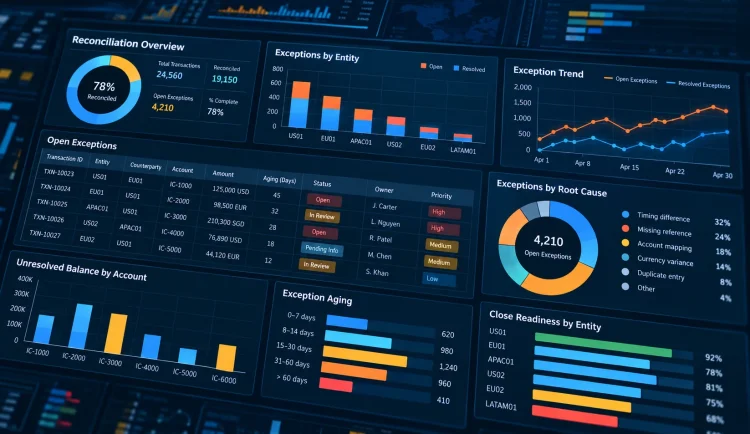
Centralized exception visibility gives intercompany accounting teams a shared view of unmatched transactions, outstanding balances, aging items, root causes, responsible owners, and resolution status. Dashboards and exception reports can help controllers monitor reconciliation completion, identify material discrepancies, and determine which items require escalation.
A useful view should do more than show a count of unmatched transactions. It should provide enough context for finance teams to understand the nature of each exception, its potential reporting impact, who is responsible for resolving it, and when action is expected.
How It Works
- Consolidate exception data: Bring unmatched transactions, outstanding balances, reconciliation statuses, and adjustment records into a shared reporting environment.
- Categorize discrepancies: Group intercompany accounting exceptions by root cause, legal entity, account, materiality, and aging to support meaningful prioritization.
- Assign clear ownership: Designate responsible individuals or teams, resolution deadlines, and escalation paths for outstanding items.
- Configure visibility and alerts: Use dashboards to monitor overdue exceptions, recurring discrepancies, material balances, and close-critical issues.
- Review resolution progress: Assess outstanding items with entity controllers and corporate finance, track exception aging and resolution times, monitor unresolved balance values, and identify recurring discrepancies that require corrective action.
Why It Matters
Centralized visibility reduces the time spent chasing updates across spreadsheets and email conversations. Finance leaders can see which entities have completed their reviews, which differences remain unresolved, and where additional support or escalation may be needed.
It also supports more effective resource allocation. Teams can prioritize exceptions based on materiality, aging, and reporting risk rather than treating every mismatch as equally urgent. Tracking resolution times, unresolved balance values, and recurring exception trends can help controllers identify process weaknesses and assess whether intercompany reconciliation is becoming more efficient.
Dashboards create value only when they are supported by accurate, timely data and clear ownership. A shared view without an established resolution process may make problems easier to see without making them easier to resolve. Regularly reviewing performance measures alongside the causes of discrepancies helps finance teams improve accountability while maintaining appropriate reconciliation controls.
Step 6: Strengthen Governance, Documentation, and Accountability
What It Is
Faster matching and more frequent intercompany reconciliation can improve operational efficiency, but they must be supported by appropriate financial controls. Governance helps ensure that discrepancies are investigated consistently, adjustments are authorized, and intercompany reconciliation activity remains traceable as business complexity increases.
Reconciliation governance is the framework of responsibilities, documented procedures, approval requirements, segregation of duties, audit trails, and escalation protocols that supports accurate and accountable reconciliation.
It defines who prepares, reviews, approves, and certifies reconciliations, as well as what evidence must be retained. It should also establish how manual adjustments are investigated and authorized, and how unresolved or material differences are escalated.
How It Works
- Define responsibilities: Establish clear ownership across intercompany accounting teams, entity controllers, shared services, and corporate finance.
- Document procedures: Standardize reconciliation instructions, evidence requirements, exception classifications, and certification processes.
- Establish approval controls: Define segregation-of-duties requirements, adjustment authorization limits, and review responsibilities.
- Maintain audit trails: Capture transaction histories, investigation notes, supporting documents, adjustments, approvals, and timestamps.
- Monitor control effectiveness: Review aged exceptions, recurring adjustments, policy deviations, and unresolved material balances, then update procedures where necessary.
Why It Matters
Strong governance helps prevent unexplained adjustments and ensures that intercompany reconciliation outcomes can be supported with appropriate documentation. Clear responsibilities reduce uncertainty about who must investigate an exception, approve an adjustment, or certify a balance.
For finance leaders, consistent procedures and traceable records can support audit readiness and improve confidence in consolidated financial reporting. Governance also reduces dependence on individual employees’ knowledge by making processes repeatable across entities and reporting periods.
The objective is not simply to close reconciliations faster. It is to maintain appropriate review, documentation, and authorization while reducing avoidable manual effort. Regularly reviewing controls and exception trends helps ensure that process improvements remain effective as transaction volumes, systems, and organizational structures evolve.
Why are intercompany transactions eliminated during consolidation?
Intercompany transactions are eliminated during consolidation because consolidated financial statements present a corporate group as a single economic entity. Removing internal receivables, payables, revenues, and expenses prevents transactions between group entities from inflating reported balances or being counted as external business activity.
Common Mistakes to Avoid in Intercompany Reconciliation
Even a well-designed intercompany reconciliation process can be undermined by practices that conceal underlying issues or weaken controls.
| Do | Don’t |
|---|---|
| Investigate recurring differences to identify upstream process failures. | Treat recurring discrepancies as routine adjustments. |
| Prioritize exceptions based on materiality and reporting risk. | Give every mismatch the same level of attention. |
| Preserve original transaction records when correcting errors. | Overwrite source data and lose transaction history. |
| Reassess procedures after acquisitions or restructuring. | Assume existing workflows will automatically accommodate new entities. |
| Coordinate with tax, treasury, and operational teams on cross-functional discrepancies. | Treat every intercompany issue as an accounting-only problem. |
| Validate changes to matching rules before deployment. | Change automation logic during critical close periods without adequate testing. |
The goal is not to eliminate every exception indiscriminately. It is to prevent avoidable differences, resolve material discrepancies appropriately, and ensure that legitimate timing differences are documented and reviewed.
Building a More Predictable and Controlled Reconciliation Process
Intercompany reconciliation bottlenecks often stem from fragmented data, inconsistent transaction practices, manual matching, and unclear accountability. Addressing them requires a coordinated approach that:
- Establishes consistent intercompany accounting policies and transaction cut-off dates.
- Identifies discrepancies before month-end through recurring reconciliation.
- Automates matching while retaining human oversight of exceptions.
- Integrates financial data across ERPs and legal entities.
- Improves visibility into outstanding balances, owners, and resolution timelines.
- Strengthens documentation, approvals, and audit trails.
When these capabilities work together, finance teams can reduce manual effort, resolve discrepancies earlier, and support a more predictable financial close without compromising financial controls.
Accelerate Your Financial Close With Mindstream Analytics
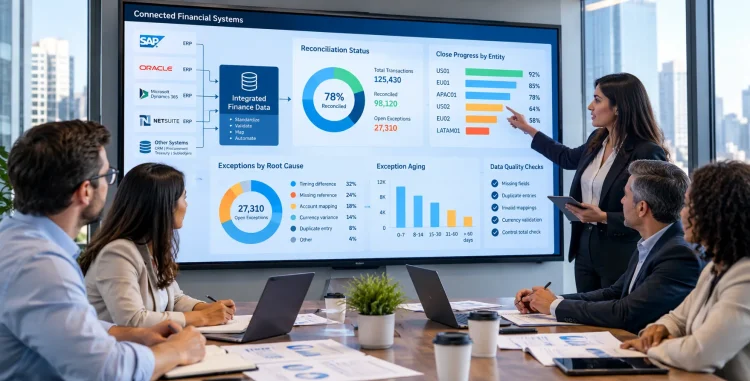
Eliminating intercompany reconciliation bottlenecks requires connected processes, reliable financial data, effective exception management, and controls that support accurate reporting. MindStream Analytics helps organizations address these requirements through finance transformation expertise and OneStream capabilities across consolidation, financial close, and reporting.
For organizations managing transactions across multiple ERP systems, MindStream Analytics can help integrate financial data into a governed enterprise environment, supporting consistent information flows and traceability to source records. MindStream helps teams evaluate where rule-based matching, validation, and exception workflows can reduce manual reconciliation effort. Its AI-assisted implementation methodology supports rapid development and refinement of the solution; production matching capabilities and configurations should be described according to the verified OneStream functionality being used.
MindStream starts with the customer’s existing spreadsheets, mappings, reports, and finance processes. AI agents help create an initial working prototype that finance stakeholders can test. MindStream and the client then identify improvements to reconciliation workflows, controls, and reporting; AI-assisted rebuilding supports successive versions until the agreed solution is ready for formal validation and deployment.
Its governance expertise can help establish appropriate controls, documentation, and accountability, while AppCare managed services provide ongoing support to maintain and optimize workflows as business needs evolve.
For multi-entity finance teams, this approach allows reconciliation design to be tested against actual entity mappings, transaction references, cut-off rules, and exception ownership before broader rollout. MindStream guides the finance decisions, controls, integrations, and iterative validation rather than relying on a generic one-size-fits-all configuration.
Identify Your Intercompany Reconciliation Bottlenecks
Use a short reconciliation review to identify potential gaps in transaction matching, exception handling, ERP data integration, and close controls. Receive a prioritized summary of areas to investigate.
Frequently Asked Questions
1. How can I reduce intercompany reconciliation delays without disrupting my financial close?
You can introduce improvements in phases, starting with high-volume or high-risk accounts while retaining existing close controls. Validate new workflows alongside current processes, involve entity accountants early, and expand automation after confirming data accuracy and reconciliation reliability.
2. How can I automate intercompany reconciliation across multiple ERP systems?
You can integrate transaction data from different ERPs through standardized mappings, common counterparty identifiers, and centralized reconciliation workflows. This allows you to automate matching across systems without necessarily replacing your existing ERP infrastructure.
3. How can I trust automated matching without compromising financial controls?
You can establish validated matching rules, appropriate tolerance thresholds, exception-based workflows, and formal approval controls. Retaining transaction-level traceability and human review of uncertain or material differences helps you benefit from automation while maintaining financial reporting integrity.
4. How can I demonstrate the value of intercompany reconciliation automation?
You can demonstrate the value of intercompany reconciliation automation by comparing key performance metrics before and after implementation. Track reconciliation cycle time, automatic match rates, manual effort, exception aging, unresolved balances, and close-related delays to understand how the process is changing.
You can also estimate the staff time spent on repetitive matching, manual investigation, and follow-ups to assess potential efficiency gains. Reviewing these measures alongside data accuracy, control effectiveness, and reporting visibility helps you evaluate whether automation is delivering operational value without compromising financial oversight.
Make Intercompany Reconciliation More Efficient and Audit-Ready
A coordinated approach to intercompany reconciliation can help your finance team:
- Prevent avoidable discrepancies through consistent transaction policies and aligned deadlines.
- Reduce month-end pressure by resolving differences throughout the reporting period.
- Minimize repetitive work with reliable automated matching and exception-based processing.
- Improve data consistency by integrating financial information across ERP systems.
- Accelerate issue resolution through centralized exception tracking and clear ownership.
- Strengthen reporting confidence with documented adjustments, approvals, and audit trails.
Managing intercompany reconciliation across multiple entities requires consistent policies, reliable financial data, efficient exception management, and strong controls.
MindStream Analytics combines OneStream capabilities, finance transformation expertise, and AI-powered automation to help streamline these processes, with ongoing support to maintain and optimize workflows as business needs evolve.