Find the manual work, data gaps, and reporting bottlenecks slowing your financial close, and learn how to build a faster, more connected finance process.

Your finance team may be closing the books, but how much time is spent chasing data, fixing spreadsheets, and reconciling numbers?
For CFOs and Controllers, a slow financial close is more than an accounting inconvenience. It delays financial reporting, consumes finance capacity, and leaves leaders making decisions with outdated information.
The financial close process may need modernization when teams rely heavily on spreadsheets, manual reconciliations, disconnected ERP systems, inconsistent entity-level processes, or lengthy reporting cycles. These warning signs typically indicate that existing close processes are struggling to scale with organizational complexity.
A financial close process can work well at one level of organizational complexity and become a bottleneck as the business grows. New entities, acquisitions, ERP systems, transaction volumes, and reporting requirements can expose previously manageable weaknesses.
The data burden is significant. PwC’s 2025 Slovak CFO Survey found that finance teams spend 42% of their time producing, collecting, aggregating, and processing data. PwC’s 2nd SEE CFO Compass Survey found that 40% of CFOs continue to rely on manual data adjustments for management reporting.
As complexity increases, the warning signs become harder to ignore. When your financial close depends on manual reconciliations or your financial reporting requires constant spreadsheet workarounds, the issue may no longer be an isolated process problem. It may indicate that the underlying finance environment needs to evolve.
Here are 10 signs that it may be time to rethink how your organization manages financial close, consolidation, and financial reporting.
- Your close still relies on Excel and manual work
- Finance spends more time reconciling than analyzing
- Your ERPs and financial systems are disconnected
- Your close takes weeks to complete
- Reports arrive too late for decisions
- Reporting requires constant spreadsheet workarounds
- You can’t easily trace numbers to their source
- Close processes vary across entities or regions
- Growing workloads require more finance headcount
- You can report the numbers but can’t quickly explain them

1. Your Financial Close Still Depends on Excel and Manual Work
What it is
Your financial close depends on spreadsheets, manual data collection, email approvals, and repetitive calculations to gather, validate, reconcile, and consolidate financial information across the organization.Why it matters
- Manual data entry and consolidation extend the time needed to complete the close.
- Multiple spreadsheets can create version-control problems and inconsistent numbers.
- Finance teams spend more time preparing and validating data than analyzing business performance.
- As entities, transactions, and reporting requirements grow, manual processes create more handoffs, dependencies, and opportunities for inconsistency, making the close harder to manage at scale.
Pro Tip
What not to do
Don’t try to automate every close activity at once. Start with high-volume, rules-based work and preserve human review for exceptions requiring judgment.2. Finance Spends More Time Reconciling Data Than Analyzing It
What it is
Your finance team spends too much time matching transactions, investigating discrepancies, reconciling accounts, and validating balances instead of interpreting results and identifying the business trends behind the numbers.Why it matters
- Repetitive reconciliation work extends the close cycle.
- High-volume manual matching consumes skilled finance capacity.
- Teams have less time for variance analysis and strategic decision-making.
- Reconciliation bottlenecks can delay downstream financial reporting.
Pro Tip
What should finance teams automate first when modernizing the financial close?
Finance teams should start with high-volume, rules-based activities such as data collection, reconciliation, transaction matching, consolidation, and recurring reporting tasks. Automating these repetitive workflows can reduce manual effort while allowing finance professionals to focus on exceptions and analysis.
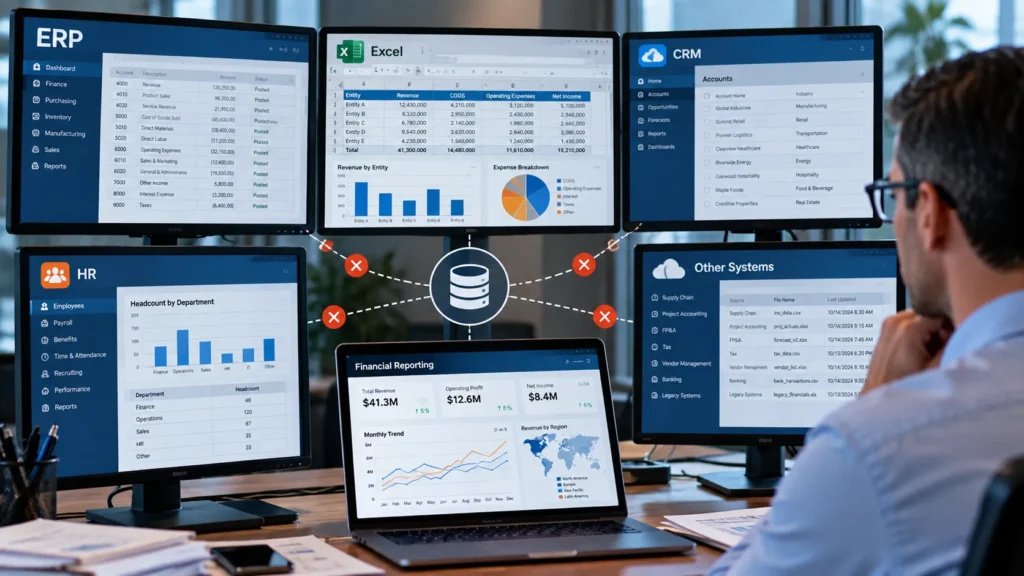
3. Your ERPs and Financial Systems Operate in Silos
What it is
Financial data is distributed across multiple ERPs, legal entities, business units, spreadsheets, and transactional systems, making it difficult to maintain consistent mappings, definitions, hierarchies, and financial information across the organization.
Why it matters
- Finance spends additional time gathering and preparing data.
- Inconsistent mappings and hierarchies can make financial consolidation slower, harder to validate, and more dependent on manual intervention.
- Data silos make enterprise-wide analysis more difficult.
- Financial reporting becomes slower and harder to standardize.
Example: A corporate finance team may need to combine data from several ERPs and regional spreadsheets before consolidation. If each system uses different mappings or definitions, finance must manually reconcile the differences before reporting can begin.
Pro Tip
MindStream Practitioner Insight: In multi-ERP environments, mapping and data-definition differences can create more friction than the systems themselves. The underlying issue is often not the number of systems, but the lack of consistent rules for how financial data is defined, mapped, governed, and consolidated. Standardizing those rules early can eliminate repeated manual cleanup downstream.
How can finance teams improve financial data visibility across multiple systems?
Finance teams can improve financial data visibility by connecting source systems through a governed data model, standardizing mappings and definitions, and creating consistent workflows for consolidation and reporting. This reduces manual data movement and makes reported numbers easier to trace.
4. Your Financial Close Takes Weeks to Complete
What it is
Your close process routinely takes weeks because teams must collect submissions, reconcile accounts, resolve intercompany differences, consolidate results, complete approvals, and manually address issues before final numbers can be reported.
Why it matters
- A prolonged close cycle delays management reporting.
- Leaders receive critical information later than they need it.
- Finance has less time to investigate variances and emerging risks.
- Delays can compound as entities and reporting requirements increase.
Pro Tip
What not to do
Don’t begin a broad transformation before identifying the specific bottlenecks extending the close. Start with the activities creating the longest waits or highest processing burden.
Why does the financial close process take longer as a company grows?
The financial close process often takes longer as organizations add entities, ERP systems, transactions, and reporting requirements without standardizing workflows and data. Manual reconciliations, disconnected systems, and inconsistent processes increase the work required to complete each close.
5. Reports Arrive Too Late to Support Timely Decisions
What it is
Your financial reporting process takes so long to prepare, reconcile, consolidate, and review that executives receive results after the most useful decision-making window has already passed.
Why it matters
- Leaders may make decisions using outdated information.
- Finance spends more time producing reports than interpreting them.
- Emerging risks and unfavorable variances may be identified later.
- Additional requests for analysis create more work for the finance team.
Pro Tip
6. Every Reporting Cycle Requires Spreadsheet Workarounds
What it is
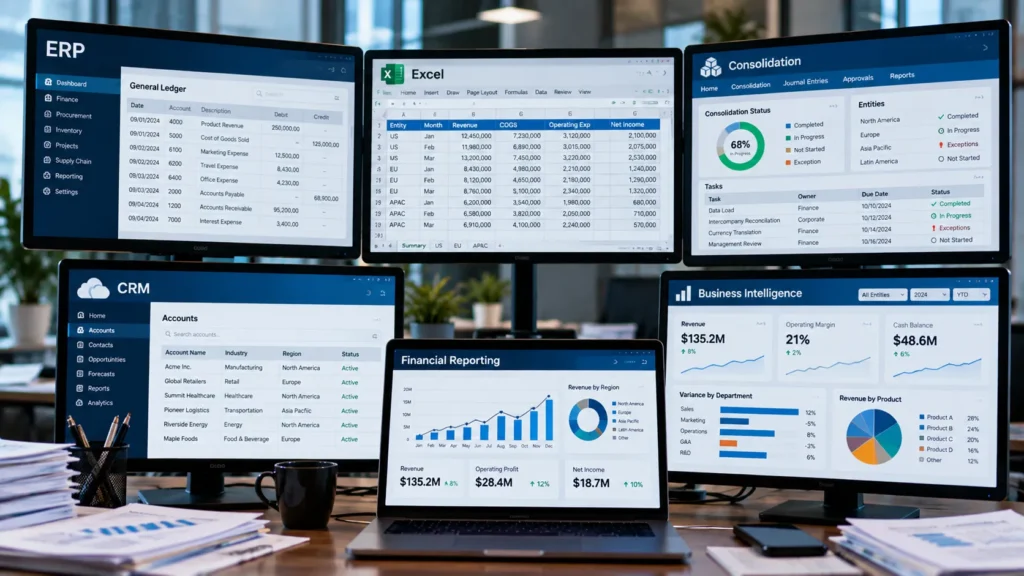
Your financial reporting process depends on offline spreadsheets, manual adjustments, copied data, or workbooks outside your core finance systems because existing workflows cannot efficiently deliver the information the business needs.
Why it matters
- Multiple spreadsheets create version-control and consistency risks.
- Manual adjustments increase reporting effort.
- Offline processes can weaken visibility and control.
- Repeated workarounds often indicate an underlying process or system gap.
Pro Tip
7. You Struggle to Trace Financial Numbers Back to Their Source
What it is
When someone questions a reported number, finance must search across spreadsheets, systems, emails, and workpapers to determine how the figure was calculated, adjusted, approved, and ultimately included in the reported results.
Why it matters
- Weak traceability makes financial reporting harder to validate.
- Finance leaders spend time reconstructing information.
- Manual processes can make governance and audit support more difficult.
- Limited visibility can reduce confidence in reported numbers.
Example: A Controller is asked why a consolidated balance changed. Instead of drilling directly into the underlying data, the team must trace the figure through an ERP export, a regional workbook, and a manual adjustment before explaining the variance.
Pro Tip
MindStream Practitioner Insight: When finance cannot trace a number without opening multiple files or systems, the issue is often process design as much as technology. Effective traceability requires more than connecting systems. It requires governed data, consistent definitions, clear ownership, and an auditable path from consolidated results to the underlying activity. Improving that flow makes reporting easier to validate and explain.
8. Close Processes Vary Across Entities, Regions, or Business Units
What it is
Different entities or regions follow different close calendars, workflows, mappings, approval processes, reconciliation methods, or reporting practices, making it harder to create a consistent enterprise-wide close process.
Why it matters
- Inconsistent processes make financial consolidation more complex and increase the manual work required to produce consistent enterprise results.
- Corporate finance must spend more time resolving differences.
- Different controls and workflows can increase governance risk.
- Financial reporting takes longer when information arrives in different formats.
Pro Tip

9. Growing Finance Workloads Require Additional Headcount
What it is
As your organization adds entities, acquisitions, transactions, and reporting requirements, finance increasingly responds by adding people to handle reconciliation, consolidation, reporting, and other recurring work.
Why it matters
- Manual processes do not scale efficiently with business growth.
- Additional headcount increases operating costs without necessarily fixing process inefficiencies.
- Skilled finance professionals spend more time on administrative work.
- Financial close and financial reporting workloads can outpace team capacity.
Pro Tip
What not to do: Don’t treat additional headcount as the first solution to a growing workload. First determine which recurring activities can be standardized or automated.
10. You Can Report the Numbers, but Can’t Quickly Explain What Drives Them
What it is
Your financial reporting process produces consolidated results, but finance cannot quickly identify the entities, accounts, vendors, transactions, or operational factors driving significant balances and variances.
Why it matters
- Reporting remains focused on what happened rather than why it happened.
- Executives must wait for additional analysis before acting.
- Finance spends more time investigating numbers after reporting.
- The organization gets less strategic value from its financial data.
Example: An executive sees a significant variance in consolidated results and asks what caused it. Finance can report the variance but needs additional analysis to determine which entity, account, transaction, or operational factor drove the change.
Pro Tip
The cost goes beyond a slower close. Every manual reconciliation, spreadsheet workaround, and disconnected system consumes finance capacity, delays decision-making, and makes growth harder to manage. As complexity increases, organizations can end up adding people to maintain processes that should be increasingly automated.
Modernize Financial Close for Faster Reporting and Better Visibility
A modern finance environment should help teams close faster, reduce manual work, and deliver timely, trusted financial reporting. But as organizations add entities, acquisitions, ERP systems, and reporting requirements, disconnected processes can make the close increasingly slow and labor-intensive.

MindStream helps address these challenges by combining finance modernization expertise, OneStream, AI-assisted delivery, and industry-specific accelerators to create unified financial data, streamlined workflows, stronger governance, and faster insight.
How MindStream Uses an Adaptive Approach to Finance Modernization
MindStream combines finance transformation expertise, OneStream, and AI agents in an iterative implementation model that allows the solution to evolve through working versions rather than relying entirely on upfront requirements and design.
- Understand What Exists: AI agents analyze existing spreadsheets, reports, process documentation, templates, mappings, requirements, systems, and other available inputs to establish the current finance environment.
- Create the Initial Prototype: AI agents use those inputs to create a working representation of the existing environment that stakeholders can experience and evaluate.
- Experience the Application: Finance, Accounting, FP&A, and other stakeholders interact with the working prototype and identify inefficiencies, gaps, workarounds, and opportunities for improvement.
- Apply Better Processes and Practices: MindStream applies finance transformation expertise, OneStream capabilities, automation, governance, controls, and agreed business decisions to determine what should change.
- Rebuild and Repeat: AI agents accelerate the work required to incorporate validated changes into the next version. Stakeholders review that version, identify further improvements, and the cycle continues until the desired future state is reached.
This approach changes the role of AI in implementation. AI agents do not make the finance decisions. They reduce the time and effort required to move between working versions, while MindStream remains responsible for solution design, architecture, controls, governance, and implementation quality.
MindStream Experience: Modernizing Financial Close at Urban Grid
Urban Grid relied on Excel for financial consolidation and faced complex ownership structures, reporting requirements, and limited financial visibility. The environment required finance to manage information across systems while relying on manual processes to support consolidation and reporting.
MindStream implemented OneStream with NetSuite integration, automated cash flow reporting, and custom dashboards. The resulting environment reduced reliance on Excel and gave the finance team faster visibility into financial performance and variances.
This example illustrates an important modernization principle: the goal isn’t simply to replace spreadsheets with new technology. The goal is to create a more connected environment where financial data, processes, reporting, and analysis work together more effectively.
How MindStream Helps Address the Warning Signs of an Outdated Financial Close
| Warning Sign | What Happens | How MindStream Helps |
|---|---|---|
| 1. Financial close depends on Excel and manual work | Close takes longer, and finance spends valuable time collecting, validating, and consolidating data. | Uses automated workflows and unified financial data to reduce repetitive collection, validation, and consolidation work. |
| 2. Finance spends more time reconciling than analyzing | Manual matching and reconciliation consume skilled finance capacity. | Automates high-volume reconciliation and transaction-matching activities so teams can focus on exceptions and analysis. |
| 3. ERPs and financial systems operate in silos | Finance must manually assemble information across entities, systems, and business units. | Unifies financial and operational data through a governed enterprise data model. |
| 4. Financial close takes weeks to complete | Delayed close pushes back management reporting and limits time for analysis. | Automates close, intercompany processing, reconciliations, consolidation, and reporting through connected workflows. |
| 5. Reports arrive too late for decisions | Executives receive historical information when they need timely business insight. | Delivers timely, governed reporting with drill-down visibility into the entities, accounts, transactions, and activity behind reported results. |
| 6. Reporting requires spreadsheet workarounds | Manual adjustments and offline files create additional work and control challenges. | Replaces fragmented workflows with integrated reporting and automated processes. |
| 7. Financial numbers are difficult to trace | Finance spends time backtracking to show how period balances were produced. | Builds traceability from consolidated financial statements into underlying entities, accounts, transactions, approvals, and operational activity. |
| 8. Close processes vary across entities or regions | Inconsistent workflows and mappings make enterprise consolidation more difficult. | Helps standardize processes, mappings, workflows, governance, and controls across the organization. |
| 9. Growing workloads require more finance headcount | Finance scales administrative work by adding people instead of increasing automation. | Automates repetitive finance activities so teams can handle growing entities and reporting requirements without scaling administrative work linearly. |
| 10. Finance can report numbers but can't explain their drivers | Leaders need additional analysis before they can understand variances or act. | Connects consolidated reporting with underlying financial and operational data for deeper visibility. |

For appropriately scoped engagements, MindStream can target implementation in approximately two months, depending on solution scope, requirements, data readiness, and client-specific factors. Its AI-assisted delivery model automates activities across discovery, requirements analysis, configuration support, testing, documentation, deployment preparation, and validation.
See What Your Finance Process Could Look Like After Modernization.
Identify the manual work, disconnected data, and reporting bottlenecks slowing your finance organization, and map a path toward a faster, more connected financial close.
Summary at a Glance
- Manual work slows the financial close and increases operational burden.
- Disconnected systems make consolidation and reporting harder.
- Slow financial reporting delays critical business decisions.
- Spreadsheet workarounds increase manual effort and create control and visibility challenges.
- Inconsistent processes make enterprise-wide standardization difficult.
- MindStream modernizes finance with OneStream, AI, automation, and unified data.
1. How do I know when my financial close process needs modernization?
You should consider modernization when your financial close relies heavily on Excel, takes weeks, requires repetitive reconciliations, or becomes increasingly difficult to manage as your organization grows. Multiple warning signs occurring together are a stronger indication that the underlying process, data, and technology environment may need to change.2. How can I make my financial reporting more useful for decision-making?
Modern financial reporting should connect trusted data with the analysis leaders need to act. Standardized data, governed reporting, variance analysis, and drill-down visibility into entities, accounts, transactions, and business drivers can help executives move from reviewing results to understanding what is driving them.3. Why is my financial close and reporting process taking so long?
Disconnected ERP systems, manual data collection, spreadsheet workarounds, inconsistent processes, and time-consuming reconciliations can slow financial close and financial reporting. The most effective starting point is to identify where data, approvals, reconciliations, or consolidation activities create the longest delays rather than attempting to automate everything at once.4. How can I reduce manual work in my financial close process?
Standardize workflows, automate repetitive reconciliations and consolidation tasks, and connect financial data across the processes that create the most manual effort. Start with high-volume, rules-based activities while preserving human review for exceptions that require judgment.5. How can I simplify financial consolidation across multiple entities?
A governed financial data model, standardized mappings, automated consolidation workflows, and consistent processes can simplify financial consolidation across entities. The goal is to establish common definitions, mappings, controls, and workflows while allowing the organization to manage legitimate differences between entities.Turn a Slow Financial Close Into a More Scalable Finance Operation
The strongest finance process improvement efforts bring user validation into the implementation early. These seven practices help teams experience the future state earlier, identify what should improve, make informed design decisions, and progressively prepare the solution and its users for go-live.
- Define what needs to be validated: Give every prototype a specific business or user question to answer.
- Engage representative finance users: Involve process owners early enough to identify operational realities.
- Use realistic finance scenarios: Ground prototypes in real data, workflows, structures, and exceptions to support finance process improvement.
- Use familiarity as a bridge: Reduce friction without carrying inefficient legacy processes forward.
- Test through real tasks: Have users perform workflows to uncover issues demonstrations may miss.
- Turn feedback into design decisions: Evaluate input against requirements, governance, controls, and the future-state design.
- Carry validation into UAT and training: Build on familiarity established through rapid prototyping to prepare users for go-live.
MindStream Analytics combines finance and OneStream expertise with AI-powered rapid prototyping, industry-specific accelerators, and AppCare to help reduce rework and accelerate time-to-value.
Start Your Finance Transformation