Cash Flow and OneStream: Powerful Reporting Guide
Cash Flow and OneStream reporting can automate complex statement activity while preserving the detail Finance needs for operating, investing, and financing analysis.
This guide compares two practical consolidation approaches and explains how account hierarchies, Flow members, formulas, schedules, and adjustment buckets work together.
The Cash Flow Statement provides information about how changes in balance sheet accounts affect cash. There are two different methods to prepare the Cash Flow Statement, the Direct and Indirect method. The Indirect method is most commonly used by companies using accrual accounting and is less complex to prepare. It reconciles net income to cash from operating, financing, and investing activities. The Direct method uses cash receipts and payments to reconcile to cash provided by operating activities.
The Cash Flow Statement is required for public companies when filing their 10Q and 10K, and many private companies also include it as part of the regular board package.
The cash flow statement is a complex statement to build, maintain, and automate. Each change in a balance sheet account must be accounted for on a line within the cash flow statement. Schedules often need to capture additions, depletions, depreciation, amortization, payments, write-offs, and other activity, and it is not unusual to have adjustments layered on top of that.
Cash Flow and OneStream Reporting Approach
The approach to building cash flow utilizes the account and flow dimensions. A standard chart of accounts includes a Balance Sheet, Income Statement, and Statistical accounts. In addition, an account hierarchy is created to capture Cash Flow Statement line items.
The following discussion is based on OneStream as a consolidation tool, but the process can be applied to other multi-dimensional consolidation systems.
Two general approaches to achieving cash flow reporting are discussed here. Which approach a company uses depends on its understanding of its own cash flows as well as the availability of the data to populate either approach.

OneStream Cash Flow Approach #1: Detailed Rollforwards
Approach #1 utilizes the basic account structure noted in the overall approach. Cash flow line items contain member formulas. A simple example would be a target cash flow account being derived from one or more source accounts.
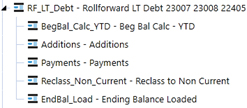
Flow members can be created to hold Ending Balance less Beginning Balance, usually referred to as Activity, along with adjustment buckets. Additional schedules can then be created to collect roll forward detail such as additions, disposals, gain/loss, transfers, amortization, and payments.
For example, in the Financing section, a Cash Flow account like Long Term Debt Principal Payments may need to pick up activity from multiple debt accounts, but only the payments portion of that activity rather than the entire activity balance.


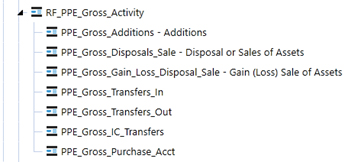
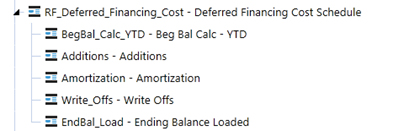

OneStream Cash Flow Approach #2: Residual Adjustments
In Approach #2, detailed rollforwards are not captured for all balance sheet items to ensure completeness. This approach works better when specific cash flow line items need to be called out for a balance sheet category, reducing the need to fully roll forward every account.
Approach #2 also uses the account and flow dimensions. Accounts are represented by the same types of cash flow line items as in Approach #1, while flow members represent balance sheet categories that are easier to group adjustments into.
The premise is to identify line items into which the general change in balance is captured, make other cash flow line items available for manual input adjustments, and calculate the residual change in balance as the periodic change in the balance sheet less adjustments entered elsewhere.
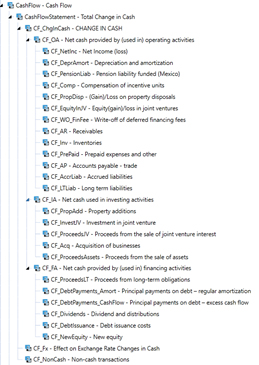
Cash Flow and OneStream Summary
There are a couple of different approaches that can be utilized to capture cash flow activity for a company’s cash flow reporting. The approach used depends on the company’s experience in cash flow reporting and the availability of the data needed to call out the activity required.
Again, the approaches shown here were built using OneStream Software as a consolidation tool, but the process can be applied to other multi-dimensional consolidation systems as well.
MindStream Analytics
Want to learn more about Cash Flow and OneStream Software? Please complete the form below and we’ll get back to you shortly.
More Cash Flow and OneStream Resources
Continue with beginning retained earnings, balance sheet and income statement hierarchies, consolidation in OneStream, streamlined financial dashboards, and OneStream reporting packages. Consult the official OneStream documentation for current platform guidance.