A OneStream implementation can become expensive when teams discover too late that the processes they built are the processes they should have changed.
Finance teams often begin implementation with existing processes, requirements, spreadsheets, reports, and workflows that need to be brought into a new environment. But requirements can evolve once stakeholders see how those processes actually work in the application. Changes discovered later can lead to additional configuration, testing, and rework, while inefficient processes can become embedded in the new system.
AI agents in finance offer a different way to approach this challenge. Instead of requiring the entire future-state solution to be defined upfront, AI agents can help rapidly prototype the customer’s existing finance environment. Finance teams can interact with working versions, identify what needs to change, and help shape the next iteration. MindStream then uses those insights to refine and rebuild the solution, incorporating improved processes, best practices, and finance automation where appropriate.
This iterative approach changes how a OneStream implementation can progress: prototype, review, improve, rebuild, and repeat. Rather than simply building today’s finance processes faster, the objective is to use the current environment as a starting point for reaching a more efficient future state, while reducing rework, complexity, and time-to-value.
What Makes MindStream’s AI-Assisted Approach Different?
A successful OneStream implementation should not simply reproduce the way finance works today. The challenge is identifying what should change and doing so before inefficient processes become embedded in the new solution.
MindStream uses AI agents in finance to make that refinement process faster and more collaborative. Rather than requiring every future-state requirement to be finalized upfront, the approach starts with the customer’s current finance environment and rapidly creates a working prototype.
Finance teams can then experience the solution, identify inefficiencies, and determine what should change, where better processes and OneStream capabilities should be introduced, and where finance automation can add value.
The process becomes a continuous cycle:
Understand what exists → Prototype → Use & Experience → Identify improvements → Apply better practices → Rebuild → Repeat
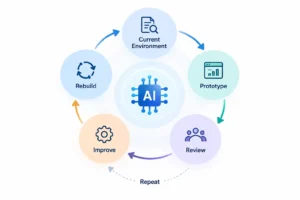
AI agents in finance accelerate the prototype, review, improve, and rebuild cycle to refine the solution through successive iterations.
Each iteration allows finance stakeholders to examine how the process works, identify unnecessary steps or gaps, and determine what should change before MindStream applies the relevant finance practices, OneStream capabilities, controls, and automation to the next version.
AI agents accelerate the work behind each iteration, while MindStream applies its OneStream and finance expertise, relevant industry practices, and implementation experience, and customers validate the direction of the solution.
Each cycle moves the application closer to a future state that is more efficient, less complex, and better aligned with how the business needs to operate. This creates an important shift: the implementation is not simply about building a predefined solution faster; it is about using rapid iterations to discover and build a better one.
How AI-Assisted Delivery Reduces Cost, Complexity, and Time-to-Value
AI agents in finance can accelerate the iterative work involved in a OneStream implementation, from rapid prototyping to refinement. By identifying improvements earlier and applying finance automation where it adds value, MindStream can help organizations reduce rework, simplify processes, and move toward a better future state faster.
1. Reduce Cost by Reducing Rework
What it means
Late-stage changes in a OneStream implementation can require additional configuration, testing, and review. AI agents in finance can help surface those changes earlier by giving finance teams a working version to evaluate before substantial implementation work is complete.
How MindStream implements it
- Rapidly prototype the current environment: AI agents in finance use existing spreadsheets, reports, process documentation, templates, mappings, and requirements to create a working prototype.
- Let stakeholders experience it: Finance teams review and interact with the prototype rather than evaluating the solution only through requirements and design documents.
- Identify what needs to change: Users can flag inefficient workflows, unnecessary steps, or processes that do not work as expected.
- Rebuild based on feedback: AI agents help incorporate those changes into the next version, while MindStream applies its finance and OneStream expertise to refine the solution, introduce appropriate best practices, and ensure the agreed changes are built correctly.
- Repeat before moving forward: The prototype → review → improve → rebuild cycle allows issues to be addressed while the solution is still evolving, before they become more expensive late-stage changes.
Why it matters
By identifying and addressing problems earlier, MindStream can help reduce the rework associated with late-stage changes. Instead of discovering after substantial configuration that a process needs to be redesigned, finance teams can shape the solution through earlier iterations, helping reduce implementation effort and keep resources focused on reaching the desired future state.
Can rapid prototyping really reduce implementation rework?
Yes. By giving finance teams a working version earlier, MindStream can surface process issues before they require extensive configuration and testing. AI agents then help incorporate feedback into the next iteration.
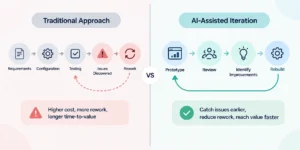
AI agents in finance can help surface issues earlier, allowing teams to reduce avoidable rework through rapid iteration.
2. Reduce Complexity by Improving Processes Through Iteration
What it means
A new OneStream application can still carry forward unnecessary steps, manual work, or inefficient workflows if existing processes are simply transferred into the new environment. AI agents in finance can support an iterative approach that helps teams identify and improve those processes before they become embedded in the future-state solution.
How MindStream does it
- Start with the current process: AI agents use existing finance materials to create a working representation of how processes operate today, giving finance stakeholders something tangible to experience and evaluate.
- Expose process inefficiencies: Finance teams can interact with the prototype and identify unnecessary steps, manual activities, workflow bottlenecks, or processes that do not support how the business operates.
- Introduce better ways of working: Based on that feedback, MindStream can refine workflows, incorporate finance and OneStream best practices, strengthen controls, and identify where finance automation can replace unnecessary manual effort.
- Rebuild and validate: AI agents help accelerate the creation of the next version, while MindStream applies its implementation expertise and the customer validates whether the revised process works better.
- Enable OneStream AI capabilities: Once workflows have been optimized, MindStream can help identify opportunities to enable OneStream AI capabilities and agentic workflows, extending the benefits of process improvement into more intelligent finance operations.
- Continue refining: Each iteration provides another opportunity to simplify the application, improve workflows, and explore further opportunities for automation and AI rather than locking inefficient processes into the final solution.
Why it matters
The value of an AI-assisted finance approach is not simply putting existing processes into a new system. It allows finance teams to improve those processes while the OneStream implementation is still evolving. By addressing unnecessary complexity before it becomes embedded, organizations can move toward simpler workflows, greater automation, and a finance application that better reflects how the business needs to operate.
Does MindStream’s approach replace existing finance processes with better ones?
The goal is not simply to recreate existing processes. The current environment becomes the starting point for identifying inefficiencies, introducing better ways of working, and determining where automation can improve the future-state OneStream application.
3. Reduce Time-to-Value Through Faster Iterations
What it means
Time-to-value is not only about reaching go-live quickly. It is also about how soon finance teams can see, evaluate, and improve a working solution. Faster prototype-and-feedback cycles allow organizations to learn what works earlier and progress toward the desired future state without waiting for the entire implementation to be built.
How MindStream does it
- Create working versions sooner:AI agents in finance accelerate the creation of prototypes from existing finance processes, requirements, reports, and other customer inputs, giving stakeholders an earlier opportunity to experience the application.
- Get to feedback faster: Instead of waiting for a substantial portion of the OneStream implementation to be configured, stakeholders can review a working version earlier.
- Accelerate each rebuild: Once feedback is received, AI agents help accelerate the work needed to incorporate agreed changes, test the revised solution, and create the next version.
- Repeat the cycle: The team moves through Prototype → Review → Improve → Rebuild repeatedly, with each cycle bringing the OneStream implementation closer to the desired future state.
Why it matters
Faster iterations give finance teams value earlier because they can experience and influence the solution before the implementation is complete. Rather than spending months building toward a solution that may require significant changes later, organizations can progress through shorter feedback cycles and reach a validated, more efficient finance environment sooner.
Does faster AI-assisted delivery mean skipping validation?
No. Faster delivery comes from accelerating the prototype-and-refine cycle, not eliminating validation. Finance stakeholders continue to review working versions, provide feedback, and validate the direction of the solution before it progresses.
From Building Faster to Building Better
AI agents in finance can accelerate individual tasks within a OneStream implementation, but speed alone does not guarantee a better outcome. MindStream’s approach to AI agents in finance uses that speed to enable a continuous cycle of prototyping, feedback, improvement, and rebuilding, helping finance teams identify what should change and refine the solution as they experience it.
| Conventional approach | MindStream’s AI-assisted approach |
|---|---|
| Build toward a defined solution. | Use working prototypes to refine the solution. |
| Feedback may result in changes after substantial configuration. | Bring feedback into the solution throughout the iteration cycle. |
| Existing processes may be carried into the new application. | Evaluate existing processes and improve them before they become part of the future state. |
| AI can accelerate individual implementation activities. | AI agents in finance accelerate the prototype → review → improve → rebuild cycle. |
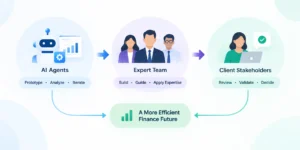
AI agents in finance accelerate prototyping and iteration while experts guide the solution and client stakeholders validate key decisions.
The model remains human-led. AI agents help create drafts and accelerate prototyping and iteration; MindStream applies its finance and OneStream expertise to refine and build the solution; and client stakeholders validate each iteration and make the final business decisions.
The distinction is important: MindStream is not simply using AI to complete the same implementation activities faster. AI agents in finance make rapid prototyping and rebuilding more practical, allowing finance teams to identify issues earlier, improve processes through successive iterations, and move toward a better OneStream solution with less avoidable rework and delay.
Summary at a Glance
- AI agents in finance can change how a OneStream implementation is delivered by enabling rapid prototyping and iterative refinement rather than relying entirely on a fully defined future state upfront.
- MindStream starts with the customer’s existing finance environment, creates a working prototype, and lets finance teams identify inefficiencies and opportunities for improvement.
- Reduce cost: Earlier feedback can help identify issues before they lead to extensive configuration, testing, and rework.
- Reduce complexity: Successive iterations allow teams to improve processes, eliminate unnecessary steps, and introduce finance automation where it adds value.
- Reduce time-to-value: AI agents accelerate the prototype → review → improve → rebuild cycle, helping organizations move toward a better OneStream implementation faster.
Build a Better OneStream Future State With AI-Assisted Delivery
A successful OneStream implementation should do more than move existing finance processes into a new application. The goal is to identify what should change, improve inefficient processes through iteration, and build toward a more effective future state.
MindStream’s approach is not simply about using AI to complete implementation tasks faster. It uses AI agents in finance to accelerate a Prototype → Review → Improve → Rebuild cycle, allowing finance teams to shape and refine the solution through successive iterations.
That approach can help reduce avoidable rework, simplify inefficient processes, and accelerate progress toward a validated future-state OneStream application. MindStream combines AI-assisted delivery with its finance and OneStream expertise, while client stakeholders validate each iteration and make the business decisions.
Ready to move beyond simply rebuilding today’s finance processes? Explore how MindStream can help you build a better OneStream solution.
Start Your OneStream Conversation
Frequently Asked Questions
1. How can I reduce the cost of my OneStream implementation with AI-assisted delivery?
AI agents in finance can help reduce rework by enabling finance teams to review working prototypes earlier and identify process changes before extensive OneStream implementation work is completed. AI agents then help accelerate rebuilding and refining each iteration.
2. Can I use AI agents to improve my finance processes instead of simply automating them?
Yes. AI agents in finance can use iterative prototypes to help identify inefficient workflows, unnecessary steps, and opportunities for finance automation. MindStream can then incorporate improved processes, OneStream capabilities, controls, and appropriate automation into subsequent iterations.
3. How can I maintain human oversight when using AI agents in my finance implementation?
AI agents in finance accelerate prototyping and delivery activities, but they do not make final business decisions. MindStream applies its finance and OneStream expertise to refine each iteration, while customer stakeholders validate the solution and determine whether the OneStream implementation meets their requirements.
Accelerate Your OneStream Transformation With AI Agents in Finance
A better OneStream implementation can reduce rework, simplify finance processes, and accelerate time-to-value through rapid, AI-assisted iteration. By combining AI agents with finance and OneStream expertise and stakeholder validation, MindStream helps organizations improve the solution as it is being built rather than discovering major changes after implementation work is complete.
Key takeaways:
- Reduce rework by identifying process issues earlier.
- Simplify complexity by improving workflows through iteration.
- Accelerate time-to-value with faster prototype-and-refine cycles.
Ready to explore how AI agents in finance can improve your OneStream implementation? Let’s talk.