



A finance dashboard combines cash flow, performance metrics, forecasts, AI insights, and automated task tracking to support finance automation.
AI is changing what finance teams can automate, analyze, and accomplish. But the value of AI doesn’t come from automating everything possible. It comes from knowing where AI can improve a finance process, where traditional automation is enough, and where finance professionals still need to make the decision. For CFOs, the real question isn’t what AI can automate. It’s “What should we automate first, and what should remain under human judgment?”
The urgency is clear. Deloitte’s 2026 CFO Signals found that 87% of CFOs expect AI to be extremely or very important to finance operations in 2026, while 49% say automating processes to free employees for higher-value work is a top finance talent priority. Yet Gartner’s latest research found that although 84% of finance organizations have implemented or plan to implement AI, only 7% report high or very high impact.
For enterprise finance teams, applying AI becomes more complex as finance environments span multiple entities, ERP systems, business units, locations, acquisitions, and disconnected data sources. Differences in processes, data structures, systems, reporting requirements, and data quality can make it harder to identify where AI can deliver value and how solutions can scale across the organization.
That’s why finance automation should not be treated as synonymous with AI. Rules-based automation is well suited to structured, repeatable processes, while AI can help interpret patterns, investigate variances, support analysis, and handle more adaptive workflows. The strongest finance transformation strategies combine both, using each where it creates the most value while keeping financial judgment and accountability with people.
This guide shows CFOs how to identify the right AI opportunities, automate core Accounting processes, improve reporting, extend finance automation into financial planning automation and FP&A automation, and scale these capabilities through AI-powered delivery. It provides a practical path from identifying AI opportunities to implementing, expanding, and scaling finance transformation through five steps:
- Step 1: Identify Finance Processes Where AI Can Create Measurable Value
- Step 2: Combine AI and Automation Across Accounting and Financial Close
- Step 3: Use AI and Governed Data to Improve Financial Reporting
- Step 4: Extend AI Into Financial Planning, Forecasting, and FP&A Automation
- Step 5: Accelerate Finance Transformation With AI-Powered Delivery
Step 1: Identify Finance Processes Where AI Can Create Measurable Value
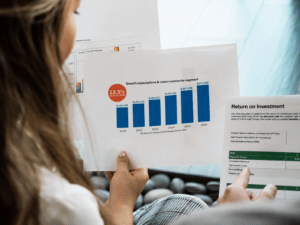
Financial charts showing growth expectations, market activity, and return on investment to support informed finance automation decisions.
Before investing in finance automation, CFOs need to determine where technology can create the greatest business value and whether AI, rules-based automation, or broader process redesign is the right approach.
McKinsey’s 2025 survey of 102 CFOs found that 44% were using generative AI across more than five finance use cases, up from 7% the previous year, showing how quickly AI applications are expanding across finance.
The strongest opportunities are not necessarily the processes with the most AI potential. They are the processes where technology can produce a measurable improvement without creating unnecessary risk.
Highly structured, repetitive activities may be better suited to rules-based finance automation, while processes involving pattern recognition, anomaly investigation, forecasting, or contextual analysis may benefit from AI. The first step is therefore to determine which technology approach fits the process rather than assuming every automation opportunity requires AI.
What to Do
- Inventory finance processes across accounting and FP&A, from close and reconciliations to budgeting, forecasting, and reporting.
- Prioritize processes based on business value, automation readiness, AI suitability, data quality, control risk, and measurable outcomes.
- Use rules-based finance automation for structured, repeatable work and reserve AI for processes where interpretation, pattern recognition, anomaly detection, or adaptive analysis can add meaningful value.
- Define measurable targets for capacity, accuracy, cycle time, or efficiency before investing in finance automation strategy.
How can CFOs prepare their teams for AI adoption in finance
CFOs can prepare finance teams by building AI literacy, clarifying where human judgment remains essential, and involving employees in selecting and validating use cases. Training, clear responsibilities, and transparent communication can improve adoption while helping teams understand how AI will change their workflows.
Real-World Example
MEPPI, a global manufacturer of switchgear and switchboard products, had relied on Infor CPM for more than a decade, but its planning environment had become slow, cumbersome, and difficult to manage. Manual intervention also created disjointed models and reporting delays, making it harder for finance teams to manage planning effectively.
Rather than immediately recommending a replacement, MindStream Analytics first assessed MEPPI’s finance challenges, business requirements, processes, and workflows. It then helped prioritize requirements, evaluated multiple vendors, and assessed potential solutions against MEPPI’s specific needs. After comparing four vendors, MindStream recommended OneStream based on its functionality, fit with MEPPI’s requirements, and scalability.
The transformation approach demonstrates an important principle for AI-enabled finance automation: technology should follow the finance problem, not the other way around. By assessing processes, requirements, workflows, data, and scalability first, finance leaders can determine where traditional automation, AI, or broader process redesign is most appropriate before committing to a solution.
For CFOs, the lesson is to understand the business need first, assess requirements and workflows, evaluate available solutions, and select technology based on fit rather than starting with a predetermined platform.
Why It Matters
Without prioritization, finance teams chase isolated AI pilots that add complexity instead of removing it, even when each one seems valuable on its own. Applying consistent criteria ensures the highest-value, lowest-risk processes are automated first, avoiding wasted effort while building a foundation of standardized data and governance for broader finance automation.
Step 2: Combine AI and Automation Across Accounting and Financial Close

A digital financial dashboard combines business performance, market analysis, financial metrics, and growth trends to support data-driven finance automation.
Once the right AI opportunities are identified, finance teams can apply finance automation to high-volume Accounting and financial close activities, including consolidation, reconciliations, transaction matching, and intercompany processing. McKinsey estimates that 42% of finance activities can be fully automated and another 19% mostly automated with demonstrated technologies.
AI can support this work at three levels. Fully automate repeatable, rules-based activities with predictable outcomes; automate standard cases and route exceptions to finance professionals; or use AI as an assistive tool for judgment-intensive work by surfacing insights, preparing information, and supporting decisions without replacing human oversight.
What to Do
- Identify repetitive, high-volume activities such as reconciliations, transaction matching, consolidation, and intercompany processing that consume significant finance capacity.
- Document the rules, workflows, thresholds, and decision criteria, then define exceptions that require finance professional review.
- Automate standard cases that follow established rules and route exceptions to finance professionals for appropriate review and resolution.
- Measure cycle time, accuracy, exception rates, rework, and finance capacity released to evaluate finance automation performance and business impact.
Real-World Example
Flanders, a company serving the mining, oil & gas, marine, power, mills, and engine industries, relied on Excel-based consolidation and manual processes for currency translations and intercompany eliminations. These activities followed defined processes and involved repeatable calculations, making them strong candidates for finance automation. However, the manual work increased effort and created opportunities for inconsistency during recurring consolidation activities.
MindStream Analytics implemented OneStream Consolidation and Reporting to automate currency translations, intercompany eliminations, and cash-flow analysis while adding data-quality controls. This approach shifted recurring consolidation work from manual processing to a more consistent, controlled workflow.
The measurable result was significant. Monthly consolidation time fell from five days to two days, reducing manual effort while improving consistency and strengthening controls. The improvement also gave finance teams a faster, more efficient approach to recurring close activities.
For CFOs, the lesson is to prioritize repeatable, rules-based finance activities where automation can reduce manual effort, accelerate close, and strengthen control without removing necessary human oversight.
Why It Matters
Not every finance activity requires the same level of automation. Applying finance automation to repeatable, rules-based Accounting and close activities can reduce manual effort, shorten cycle times, improve consistency, and strengthen controls. Routing exceptions and judgment-intensive work to finance professionals ensures automation increases capacity without removing the human oversight needed for complex financial decisions.
Step 3: Use AI and Governed Data to Improve Financial Reporting
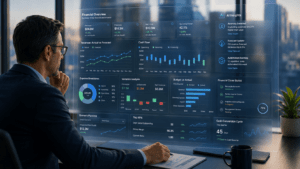
A financial dashboard brings together performance metrics, cash flow, forecasting, scenario planning, and AI insights to support finance automation and financial decision-making.
Automating financial reporting can help finance teams move beyond manually compiling data and preparing recurring reports. Finance automation can streamline report preparation while connecting governed financial data, identifying variances and anomalies, and helping teams trace changes to their underlying drivers.
Gartner’s 2026 AI Implementation Guide on Augmented Business Analytics highlights AI-driven analytics for diagnosing finance outcomes, tracing variances to underlying drivers, and supporting reporting and management commentary.
This enables finance teams to move beyond preparing reports toward understanding what changed, why it changed, what requires attention, and what action may be warranted.
AI can help identify anomalies, surface patterns, and accelerate variance investigation, while governed financial data and finance professionals provide the context and judgment needed to interpret those findings.
What to Do
- Automate recurring report preparation and distribution using standardized workflows, reducing manual compilation and creating a consistent reporting process.
- Connect governed financial data across systems and entities, giving reports consistent inputs and improving access to trusted information.
- Identify variances and anomalies, then trace significant changes to underlying drivers so finance teams can understand what changed.
- Enable finance professionals to review findings, investigate exceptions, and deliver timely insights that support informed business decisions.
Why It Matters
AI-powered reporting depends on unified, governed financial data, rather than simply layering AI onto disconnected spreadsheets and systems. Combining finance automation with connected data can reduce the time finance spends assembling reports and give teams more time to explain variances, identify risks, control spending, and support executive decisions. Drill-down capabilities can further help teams trace consolidated results to underlying entities, accounts, vendors, transactions, and operational activity.
What are the key benefits of AI for financial forecasting and predictive analytics?
AI can strengthen financial forecasting and predictive analysis by analyzing larger volumes of historical and current data, identifying patterns, and testing multiple drivers faster than manual analysis. These capabilities can help finance teams identify emerging trends, evaluate potential outcomes, and make planning decisions with greater context.
Step 4: Extend AI Into Financial Planning, Forecasting, and FP&A Automation

An AI-powered FP&A dashboard combines planning, forecasting, performance trends, prediction accuracy, and connected data sources to support finance automation.
AI in finance can extend finance modernization beyond transaction processing into financial planning automation, budgeting, forecasting, and scenario analysis.
FP&A automation can reduce the administrative work involved in updating models, consolidating inputs, and maintaining forecasts, while AI can accelerate variance analysis, scenario evaluation, pattern recognition, and identification of emerging trends.
Together, these capabilities allow finance professionals to spend less time maintaining planning processes and more time evaluating assumptions, risks, and business implications.
What to Do
- Centralize inputs from financial systems, business units, and operational sources to create consistent, trusted data for financial planning automation.
- Automate model and data updates to keep planning environments current and strengthen FP&A automation across recurring planning cycles.
- Establish planning drivers and run scenarios to evaluate how changing assumptions could affect financial performance and support financial planning automation.
- Compare actuals with forecasts, investigate variances, validate assumptions, and update forecasts as business conditions change through FP&A automation.
Real-World Example
Interface, a global modular flooring manufacturer, relied on five regional forecasting processes that created a fragmented, labor-intensive FP&A environment. Its forecasting cycle could take approximately 30 days, leaving forecasts nearly a month behind and limiting timely visibility into performance.
MindStream Analytics consolidated the five regional processes into one OneStream environment, introduced a 36-month rolling forecast, and automated input forms and reports to strengthen financial planning automation. This created a unified planning process rather than maintaining separate regional approaches.
The measurable result was an 83%+ reduction in forecast cycle time, from approximately 30 days to five days. This reduced manual effort while improving forecast visibility and creating a more consistent, scalable approach to maintaining and updating forecasts.
This demonstrates why CFOs should address fragmented planning processes before simply adding finance automation. A unified planning environment, supported by standardized processes and automation, can shorten planning cycles while improving consistency, visibility, and scalability.
Why It Matters
Financial planning automation and FP&A automation should automate the administrative work surrounding planning, including maintaining models, updating forecasts, and preparing scenarios. Finance professionals should retain responsibility for assumptions, business context, risk assessment, and strategic decisions. Combined with finance automation, these capabilities free teams to focus on evaluating what the numbers mean and determining how the business should respond.
Step 5: Accelerate Finance Transformation With AI-Powered Delivery![]()

An integrated financial dashboard combines performance metrics, forecasts, variance analysis, cash flow, and AI-driven insights within a finance automation environment.
AI-powered delivery extends finance automation beyond the processes finance teams operate every day and into the transformation process itself. MindStream uses purpose-built AI agents to work with customer spreadsheets, reports, process documentation, mappings, templates, and business requirements across discovery, requirements analysis, solution design, prototyping, testing, documentation, and validation.
Instead of asking stakeholders to wait months to see the future solution, AI agents and rapid prototyping can turn customer information into working dashboards, reports, planning models, reconciliations, and workflows early in the engagement. Finance and business stakeholders can review and refine the solution before implementation is complete, helping improve requirements, reduce rework, and build confidence earlier.
Combined with industry-specific accelerators and deep finance transformation expertise, this AI-powered delivery model can shorten implementation timelines, reduce implementation effort and project risk, and accelerate time-to-value.
What to Do
- Use purpose-built AI agents to analyze spreadsheets, reports, process documentation, mappings, and requirements during discovery.
- Rapidly prototype dashboards, reports, planning models, reconciliations, and workflows using the organization’s own information.
- Involve finance and business stakeholders early to validate requirements and identify changes before implementation is finalized.
- Use industry-specific accelerators to begin with relevant finance processes, dashboards, reports, and proven practices rather than designing everything from scratch.
- Apply AI agents throughout implementation to accelerate configuration support, mappings, testing, documentation, validation, and deployment preparation.
- Measure the impact through implementation time, rework, project effort, user adoption, and time-to-value.
Why It Matters
Rapid prototyping lets finance teams see and validate future-state solutions using their own information before implementation is complete. This helps refine requirements earlier, reduce rework, build stakeholder confidence, and support faster adoption. By validating solutions before configuration is finalized, finance automation can move from concept to usable capability with less implementation risk.
How can finance leaders scale AI beyond initial pilot projects?
Finance leaders can scale AI by validating successful use cases, establishing governance, strengthening technical capabilities, and creating a roadmap tied to measurable business outcomes. Scaling also requires adapting workflows, developing employee capabilities, and expanding AI into connected finance processes rather than deploying isolated tools.
Common Mistakes to Avoid With AI and Finance Automation
AI can create meaningful value across finance, but poor prioritization, weak processes, and insufficient governance can undermine results. Before scaling finance automation, CFOs should ensure each initiative has a clear business case, reliable inputs, appropriate controls, and measurable outcomes.
| Do | Avoid |
|---|---|
| Prioritize AI opportunities based on process readiness, data quality, business value, feasibility, and risk. | Avoid automating before assessing readiness or selecting a process simply because AI makes it possible. |
| Apply automation according to the level of judgment required, with appropriate human oversight. | Don’t automate judgment-heavy work indiscriminately or treat AI outputs as automatically accurate or complete. |
| Connect governed financial data before using AI to generate reports, insights, or recommendations. | Never generate insights from ungoverned or fragmented data that can produce inconsistent or unreliable results. |
| Validate AI-generated forecasts and planning outputs against business assumptions, actuals, and relevant business context. | Resist accepting AI forecasts without validation or removing finance professionals from reviewing assumptions, risks, and business implications. |
| Build continuous optimization into the transformation lifecycle through ongoing enhancements, governance, and measurement. | Avoid treating implementation as the end of transformation or assuming go-live means the finance environment no longer needs to evolve. |
| Connect individual AI initiatives to a broader finance transformation roadmap and integrated finance environment. | Stop treating isolated AI pilots as a finance transformation strategy; disconnected initiatives can add complexity instead of creating an integrated finance environment. |
What CFOs Should Know Before Scaling AI in Finance Automation
AI can expand finance capacity and improve reporting, planning, and decision-making, but sustainable value depends on choosing the right opportunities, establishing the right foundation, and scaling AI within a broader finance transformation strategy.
- Identify high-value, finance automation-ready processes based on business value, data quality, process maturity, and risk.
- Automate repeatable Accounting and financial close activities while routing exceptions and judgment-intensive work to finance professionals.
- Build reporting around unified, governed financial data to improve visibility, traceability, and timely insight.
- Extend financial planning automation and FP&A automation into planning, forecasting, scenario analysis, and variance investigation.
- Scale finance transformation through AI-powered delivery, rapid prototyping, implementation accelerators, and continuous optimization.
- Maintain governance, human oversight, and measurable outcomes throughout implementation and beyond go-live.
The goal isn’t to automate everything. It is to create a connected finance environment where AI handles appropriate work while finance professionals focus on judgment, risk, analysis, and strategic decisions.
Turn AI Opportunities Into Finance Automation
AI can create meaningful gains across finance, but sustainable value comes from embedding it within a broader finance transformation strategy. CFOs can identify high-value opportunities, redesign processes, unify and govern financial data, modernize Accounting and FP&A through OneStream, and use AI-powered delivery to accelerate implementation and continuous optimization. This approach can help organizations achieve faster close cycles, shorter planning cycles, improved forecast accuracy, trusted financial data, and stronger executive visibility.
MindStream Analytics combines deep finance expertise, OneStream implementation experience, purpose-built AI agents, rapid prototyping, industry-specific accelerators, governance, and AppCare to modernize complex enterprise finance environments. AI is embedded throughout the transformation lifecycle, from discovery and solution design through implementation and continuous optimization.
AI operates within this broader transformation framework, supporting finance automation alongside process redesign, unified data, governance, implementation, and continuous optimization. This approach can reduce implementation risk and cost while accelerating time-to-value.
From Accounting and financial close to reporting, planning, forecasting, and FP&A, MindStream helps organizations build connected finance capabilities that evolve with changing business needs while delivering measurable operational and strategic value.
Ready to turn AI opportunities into measurable finance outcomes?
Frequently Asked Questions
Q1. What are the risks of using AI in finance?
The main risks of using AI in finance include inaccurate outputs, poor data quality, weak governance, security concerns, and overreliance on automated decisions. Finance teams should establish controls, maintain human oversight, and ensure AI-generated outputs are traceable to reliable financial data.
Q2. Can AI integrate with my existing finance systems?
Yes, AI can integrate with existing finance systems when the underlying data, processes, and system architecture are suitable. Organizations can connect AI capabilities with existing ERPs, financial platforms, and data sources, allowing them to modernize finance processes without replacing their entire technology environment.
Q3. What data do I need before implementing AI in finance?
AI implementation requires reliable financial, operational, and process data relevant to the selected use case. Data should be accessible, consistent, governed, and sufficiently accurate to support analysis, automation, and decision-making. Organizations should assess data readiness, process maturity, and integration requirements before implementing AI in finance.
Q4. How do I measure the ROI of AI in finance?
Measure the ROI of AI in finance by tracking outcomes such as reduced cycle times, lower manual effort, improved accuracy, faster reporting and forecasting, fewer exceptions, and increased finance capacity. Establish measurable baselines before implementation and compare them with post-implementation results to determine whether finance automation is delivering sustained business value.
Q5. How do I know which finance processes are ready for AI?
Finance processes are generally strong candidates for AI when they involve repetitive work, clear rules, reliable data, measurable outcomes, and significant manual effort. CFOs should also consider process maturity, implementation feasibility, risk, scalability, exception rates, and the level of human judgment required before prioritizing finance automation opportunities.
Build a More Agile, AI-Ready Finance Function
AI can reduce repetitive work, shorten finance cycles, improve financial visibility, and expand finance capacity. But these benefits depend on connecting finance automation to process redesign, unified data, governance, technology implementation, and continuous optimization.
Key takeaways
- Identify finance processes where AI can deliver value.
- Apply finance automation across Accounting, close, and reconciliations.
- Use governed financial data for timely insights.
- Extend financial planning automation and FP&A automation into forecasting.
- Use rapid prototyping and AI-powered delivery to accelerate transformation.
- Optimize finance environments through governance, enhancements, and AppCare.
Turn AI opportunities into measurable finance transformation.
Related Articles
The Importance of Effective Financial Reporting
How Much Information is Too Much? Rethinking the Reporting Book
Oracle Analytics Cloud ‘Explain’ Feature Hints at the Power of Machine Learning
Research & References
https://www.deloitte.com/us/en/about/press-room/deloitte-q4-2025-cfo-signals-survey.html
https://www.gartner.com/en/documents/7611965
https://www.deloitte.com/us/en/about/press-room/deloitte-q4-2025-cfo-signals-survey.html
Categories
Recent Posts
How to Use AI in Finance Automation for Smarter Modernization
How to Use Finance Automation to Reduce Workload Without Adding Headcount
The Cost of Delaying Finance Modernization For Financial Planning and Analysis