How an Oracle PBCS Source Dimension Improves Planning
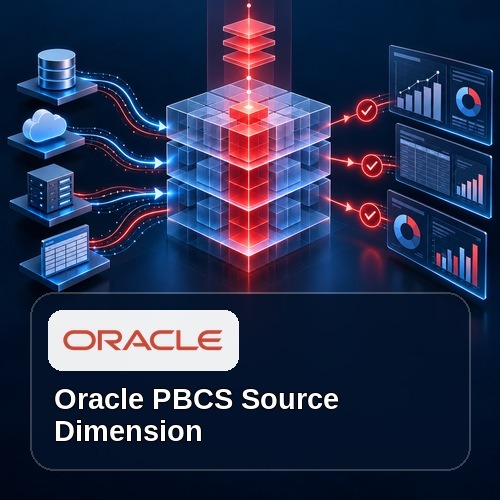
An Oracle PBCS source dimension gives planning teams a clear, auditable way to identify where every value originated. When data enters the application through forms, Smart View, integrations, adjustments, calculations, or rollover processes, a dedicated Source member preserves that lineage and makes reconciliation, reporting, and troubleshooting faster.
Dimensions are the components that label, store, and arrange data. Each dimension contains a hierarchy of related members grouped in a parent/child structure. In Oracle Planning and Budgeting Cloud (PBCS), there are seven dimensions out of the box which are Account, Currency, Entity, Period, Scenario, Version, Year. (See the links for each of the Oracle Docs for information on each of these dimensions.)

You can also create up to 13 user-defined custom dimensions. One of the user-defined dimensions that should be essential for any organization that loads data from multiple sources is the Source dimension.
The Source dimension allows users and administrators to readily identify the location from which the data originated. Common types of sources are:
- Input – data that input to the application via Smartview or Data forms by the Planning users
- Adjustment – data that top-sides the calculated or source system data
- Calculation – data that is calculated in the system, usually through a business rule. More detailed calculation options are below
- Rollover – data that is copied or “rolled over” from prior periods or years. The generally applies to Balance Sheet data. You could also use the “Calculated Source” for this purpose but Rollover adds more clarity
- Allocation – data allocated from one member to across many members, usually based on an Allocation_% across Entities or Products
- Source Systems – data that is loaded from another system or systems to the PBCS Target application, usually via Data Management
- PBCS Source – data that is transferred between PBCS plan types via XRef, XWrite, Data Map, or Data Management
- FCCS Source – data that is transferred from FCCS to PBCS

Source dimensions are especially useful for data reconciliation. It is often difficult to reconcile slices of data to a specific source once data is aggregated in the database. With a source dimension, users can refresh the dataset with the specific source member and compare to source information.
For reporting, “Total_Source will combine all of the data at the aggregated level.
So, does your organization use a “Source” dimension in the application? If not, I strongly recommend this during your next upgrade.
Oracle PBCS Source Dimension Design and Governance
A well-designed source dimension should reflect meaningful business origins rather than every technical job name. Common members include Input, Adjustment, Load, Calculation, Rollover, and Allocation. Create a consistent naming standard, assign an owner to each member, and document which process writes to it.
Place source members beneath a Total_Source parent so reports can show both consolidated results and the contributing layers. This structure lets analysts compare loaded actuals with manual adjustments, isolate calculated values, and explain variances without rebuilding the data trail outside Planning.
The source dimension also strengthens controls. Data forms and integration rules can direct values to approved source members, while security can limit who may enter or change adjustments. Validation rules should reject missing or unexpected source values before a load reaches production.
For reconciliation, compare each source member with its originating system before reviewing Total_Source. If a difference appears, the team can identify whether it came from an incomplete load, a manual entry, a business rule, or a rollover. This targeted review shortens investigation time and produces clearer audit evidence.
Govern the Oracle PBCS source dimension as application requirements evolve. Review members before each planning cycle, retire obsolete sources carefully, and test aggregation after metadata changes. Keep integrations, forms, business rules, reports, and documentation aligned so the same source definition is used throughout the application.
Oracle PBCS Source Dimension Resources
For more guidance on an Oracle PBCS source dimension, explore Oracle PBCS services, what PBCS is, Oracle Planning and Budgeting Cloud Service, Oracle EPM Cloud, valid data intersections in Oracle PBCS. Also review the official Oracle documentation for dimension design.