Hyperion Planning: Powerful Oracle Budgeting
Oracle’s planning application gives finance teams a structured way to build budgets, forecasts, and operational plans while preserving the calculation depth of Essbase. It combines multidimensional modeling, guided workflow, business rules, and familiar Microsoft Office access so contributors can work from a governed process instead of disconnected spreadsheets.
The platform is especially useful when an organization needs detailed driver-based models, multiple planning scenarios, formal approvals, and consistent reporting across departments. Finance can manage assumptions centrally while business users contribute the operational context behind revenue, workforce, capital, and expense plans.
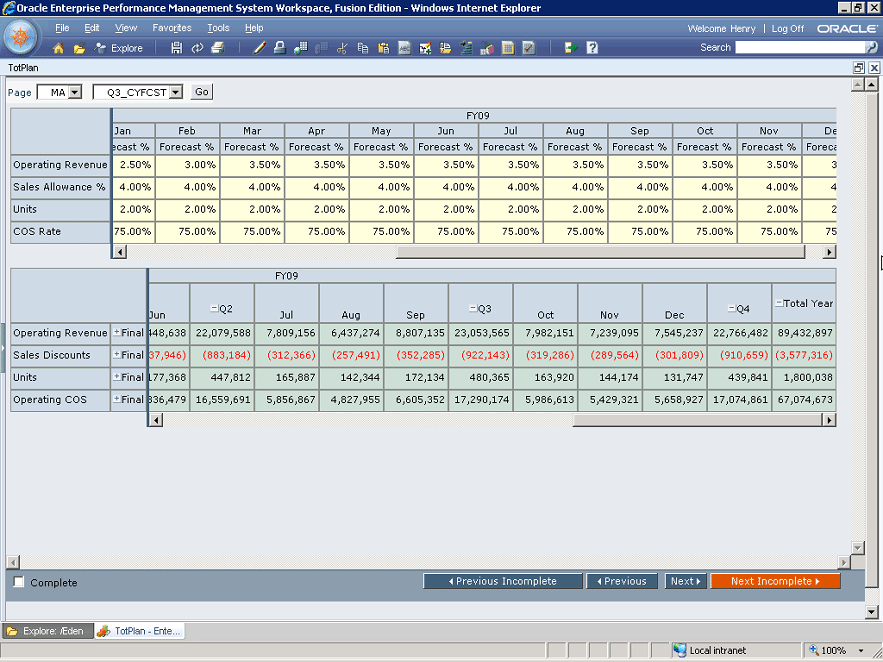
Oracle’s Hyperion Planning is a web driven Planning and Budgeting tool that utilizes Oracle Essbase as the data storage and calculation engine. By leveraging Essbase’s multidimensional data model as well as standard relational database management platforms, Oracle’s Hyperion Planning provides a powerful tool for forecasts, budgeting, reporting, and analysis. The Essbase portion of the application gives Hyperion Planning the calculation power to handle predictive planning , allocations and complicated revenue recognition planning. The relational repository allows Planning to collect textual information critical to a coordinated understanding of the budget. Hyperion Planning contains process flow management and process guidance for end users. While Hyperion Planning is a web software application, it also has an add-in with Microsoft Office (called Smartview ) which allows users to forecast or budget in Microsoft Excel, an environment comfortable to most finance users.
Hyperion Planning is part of Oracle’s Hyperion EPM software suite and is often utilized with Hyperion Financial Reports and Web Analysis to enhance the analytic value inherent in its underlying use of Essbase. Hyperion Planning has two additional add-in modules; Workforce Planning and CapEx Planning that can be purchased along with Planning.
Key features of Oracle’s Hyperion Planning:
- Multi-dimensional / multi user planning with a powerful business rules engine
- Flexible workflow and plan management capabilities
- Comprehensive Microsoft Office integration
- Easy to use Web interface
- Seamless creation of reports and dashboards
- Proven and scalable architecture.
- Robust integration with ERP systems and other sources
- Full set of administrative tools for application management
How Connected Planning Improves Decisions
A connected planning design links financial targets to the operating drivers that create them. Revenue assumptions can reflect volume, pricing, customer mix, and renewal behavior. Workforce plans can connect headcount, compensation, benefits, hiring dates, and organizational changes to the income statement. Capital plans can translate project timing into depreciation, cash requirements, and balance-sheet impacts.
This connection helps teams evaluate cause and effect instead of reviewing isolated totals. When an assumption changes, calculation rules can update the affected plan components and show the financial impact quickly. Scenario versions let decision-makers compare a baseline, an upside case, and a downside case without rebuilding the model. The result is a clearer discussion about business tradeoffs, resource allocation, and risk.
Well-designed forms should collect only the information a planner owns. Valid intersections, member security, and task lists reduce confusion and guide users through the process. Smart View can support detailed analysis in Excel, while web forms provide a controlled experience for routine submissions. Both interfaces should use the same approved dimensional structure and calculation logic.
Implementation, Governance, and Adoption
A successful implementation begins with planning requirements, not with screens. Define the decisions the model must support, the level of detail that adds value, the source systems for actuals and metadata, and the approval steps required before a forecast becomes official. Document account, entity, scenario, version, period, and custom-dimension ownership before development starts.
Calculation performance matters as models expand. Administrators should review dense and sparse dimension choices, aggregation paths, business-rule scope, data-form design, and the timing of data loads. Rules should calculate only the required slices of the database whenever possible. Regular monitoring identifies slow forms, unnecessary calculations, and process steps that make the planning cycle harder for users.
Governance also covers security, change control, testing, and documentation. Role-based access should follow business responsibility and be reviewed when people change positions. Enhancements should move through development, test, and production with clear validation evidence. Training should explain both the mechanics of entering a plan and the business logic behind each assumption so users understand how their inputs affect consolidated results.
Organizations evaluating modernization should compare current pain points with future requirements. Consider support timelines, infrastructure effort, integration needs, reporting dependencies, custom rules, data volumes, and the value of newer cloud capabilities. A phased roadmap can protect critical planning cycles while simplifying models and retiring technical debt.
Related Oracle EPM Resources
Explore our guides to Hyperion software, Hyperion consulting services, on-premises planning versus PBCS, planning versus OneStream, and Oracle EPM. For product administration and user guidance, review the official Oracle Planning documentation.
These resources can help teams assess architecture, support, upgrades, cloud migration, and long-term application strategy. The best next step is a practical assessment of the current model: inventory integrations and business rules, identify manual workarounds, measure cycle times, and prioritize improvements that increase reliability and planning value.