


AI Doesn’t Need More Data. It Needs Trusted Data.
AI-driven forecasting and decision support are only as reliable as the financial data behind them. For enterprises, building a governed, unified financial foundation is becoming essential to making AI useful, auditable, and trustworthy.
For the last two years, the enterprise software market has been flooded with AI announcements. Every platform suddenly claims to have predictive intelligence, generative reporting, conversational analytics, and autonomous workflows.
The CPM market is no different, and leading vendors across the Gartner quadrant are racing to position themselves as AI-first finance platforms.
But beneath the excitement of releasing AI capabilities into the Office of the CFO, something more fundamental is happening. AI is forcing organizations to confront the quality of their underlying financial data architecture.
AI Is Exposing the Weaknesses in Enterprise Financial Data
Finance organizations have historically tolerated fragmented planning models, disconnected operational systems, spreadsheet-based forecasting, and inconsistent reporting logic because human intervention could compensate for the gaps.

Fragmented financial data and manual analysis can make it harder for finance teams to reconcile information and produce trusted insights.
Analysts reconciled the differences, FP&A teams manually investigated variances, and executives accepted delays because everyone understood how difficult it was to consolidate information across large enterprises. AI changes that equation entirely.
As organizations move toward AI-driven forecasting and agentic decision support, the tolerance for inconsistent or ungoverned data starts collapsing. AI systems and processes amplify whatever data foundation they are given.
If the underlying information is fragmented, duplicated, or unreliable, the output becomes faster noise rather than better intelligence. That is why governed financial data may become one of the most valuable enterprise assets of the next decade.
What Makes Financial Data AI-Ready?
Financial data is AI-ready when it is unified, governed, consistent, and traceable, giving AI reliable information for forecasting, analysis, and decision-making that finance teams can validate and trust.
Finance’s Role as the Trusted Data Layer Is Becoming More Important
Finance has always been responsible for establishing “The Truth” inside an organization. Actuals are the truth. Approved budgets are the truth. Final forecasts are the truth. While other functions may debate assumptions, Finance ultimately becomes the steward of the numbers the business agrees to trust.
As AI becomes a consumer of enterprise data rather than simply a reporting tool, the value of that trusted truth layer increases dramatically. The challenge for most organizations is that establishing and maintaining that truth is extraordinarily difficult. That reality may explain why OneStream is better positioned for the AI era than many people realize.
OneStream’s Unified Architecture Gives AI a Trusted Financial Foundation
For years, OneStream’s core value proposition centered around creating a single, governed platform for financial consolidation, planning, reporting, and analysis. At times, that message sounds less exciting than some of the more flexible or decentralized planning platforms in the market. Unified architecture is not always the flashiest story during software evaluations, but the market is changing.
AI consumption models are becoming embedded into enterprise workflows, and organizations are beginning to understand that trusted data matters more than isolated features. The systems that will create the most value are not necessarily the systems with the most AI demos.
They are the systems AI can trust and can produce auditable, explainable, enterprise-wide financial truth, which is a critical distinction. Large enterprises do not simply need predictions; they need confidence in the integrity of those predictions.
They need to know where the data originated, how calculations were applied, which assumptions changed, and whether the information can withstand audit scrutiny. Finance organizations cannot operate on black-box outputs that cannot be reconciled back to governed source data. This is where OneStream’s architecture becomes strategically important.
Why Does Financial Data Governance Matter for AI?
Financial data governance ensures data has defined ownership, consistent standards, controlled workflows, and traceable changes, allowing finance leaders to validate AI outputs and maintain confidence in decisions based on them.
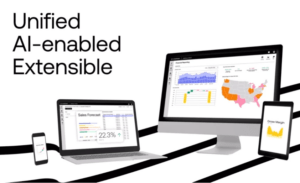
OneStream’s unified architecture brings financial reporting, forecasting, and analysis into a connected, AI-enabled environment built on governed financial data.
The OneStream platform was built around centralized metadata, governed hierarchies, controlled workflows, and unified financial models. Actuals, budgets, forecasts, and operational assumptions exist within a common framework designed to produce consistency across the enterprise. In many ways, OneStream was solving the “single version of the truth” problem long before AI made the issue existential. Now that foundation becomes dramatically more valuable.
As organizations begin deploying AI agents to generate forecasts, explain variances, recommend actions, and support decision-making, the quality of the source system becomes paramount.
AI does not eliminate the need for finance governance; it amplifies the importance. In fact, the next generation of enterprise AI may depend less on model sophistication and more on data trustworthiness.
That shift makes the way organizations implement and manage their finance environment just as important as the platform itself.
Mindstream helps enterprises build this foundation by combining OneStream expertise with a business-led finance transformation approach. The process begins by understanding existing finance processes, data sources, governance requirements, and operating models, then designing a future state that unifies financial and operational data.
This approach strengthens financial data management while creating a governed enterprise data model that supports trusted reporting, planning, forecasting, and AI-driven decision-making. AI agents and rapid prototyping further accelerate discovery and solution design, helping organizations validate the future state before implementation is complete.
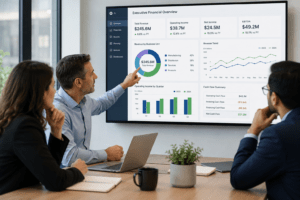
Finance leaders review trusted financial data and performance insights to support faster, more informed business decisions.
Finance Architecture Is Becoming an AI Strategy Decision
CPM evaluations often focus on usability, planning flexibility, visualization capabilities, or departmental modeling speed. Those factors still matter, but they may become secondary to a larger architectural question: which platform can serve as the trusted financial backbone for enterprise AI ecosystems? That question favors platforms designed around governance, auditability, and integrated financial intelligence.
The financial model increasingly acts as the validation layer for operational strategy, capital allocation, workforce planning, supply chain decisions, and executive forecasting. AI accelerates that convergence because organizations want automated systems operating against trusted economic realities, not disconnected departmental assumptions.
The irony is that the market may now be rediscovering the importance of disciplined finance architecture after years of prioritizing flexibility and decentralization.
What CFOs Should Do Now to Prepare Finance for AI
CFOs should unify financial data, strengthen governance, eliminate fragmented reporting processes, and establish clear data ownership and controls before expanding AI-driven forecasting, analysis, and decision support.
AI readiness starts with the financial foundation behind the technology. CFOs should focus on three priorities:
- Improve financial data management: Identify fragmented sources, inconsistent definitions, and manual reconciliation points that could undermine AI-driven analysis and forecasting.
- Strengthen governance: Create clear ownership, standardized processes, controlled workflows, and traceable data so AI outputs can be understood and validated.
- Create a unified finance foundation: Bring financial information into a consistent, governed environment that allows AI to support planning, reporting, forecasting, and decision-making.
The Next AI Advantage May Be Trusted Financial Data
That does not mean OneStream automatically wins the future. The next battle in enterprise software may not be about who builds the smartest AI. It may be about who can build the most trusted financial data foundation for it.
Finance has always been responsible for establishing the truth inside an organization. Actuals, approved budgets, forecasts, and financial results give the business a common view of its economic reality.
As AI moves deeper into forecasting, analysis, and decision support, that role becomes even more important. AI can accelerate what finance knows, but it cannot compensate for financial information that is fragmented, inconsistent, or impossible to trace.
The enterprises best positioned to realize the value of AI will be those that treat trusted financial data as infrastructure, not simply as an input. Finance transformation, therefore, is no longer only about modernizing finance processes. It is about creating the governed financial foundation on which the next generation of enterprise intelligence can operate.
Ready to build a finance foundation that can support AI with greater confidence?
Categories
Recent Posts
How to Drive Finance Process Improvement and Stronger User Adoption With Rapid Prototyping
The Complete Guide to OneStream Implementation: What Finance Leaders Need to Know
5 Signs You Need Financial Consolidation Software and May Be Ready for OneStream