Even after introducing standardized templates and tighter deadlines, reporting delays continued. Without financial close automation, getting to a reliable explanation when leadership needed to understand a variance could require pulling information from different systems, reconciling inconsistencies, and following up with regional teams.
For finance leaders, closing the books is about more than meeting a deadline. It means producing financial information that is consistent, traceable, and ready to support business decisions. As organizations expand across entities, regions, and systems, however, different data formats, manual reconciliations, and recurring follow-ups can make the financial close process increasingly difficult to coordinate and standardize.
Deloitte’s “Six Elements of a Strong Financial Close” study notes that efficient financial close and consolidation can benefit from standardized data structures, reduced reliance on fragmented data sources and manual reconciliation, and greater visibility into the close process.
Angela knew the team needed more than another spreadsheet or an additional review checkpoint. She needed a sustainable approach to financial close automation that could connect data, strengthen workflows, and support the company’s growing reporting requirements without disrupting essential accounting operations.
What is financial close automation?
Financial close automation uses technology to connect financial data, standardize workflows, and automate repeatable activities such as data collection, reconciliation, validation, and consolidation while preserving the controls, approvals, and oversight required for reliable financial reporting.
When Business Growth Made the Financial Close Process Harder to Coordinate

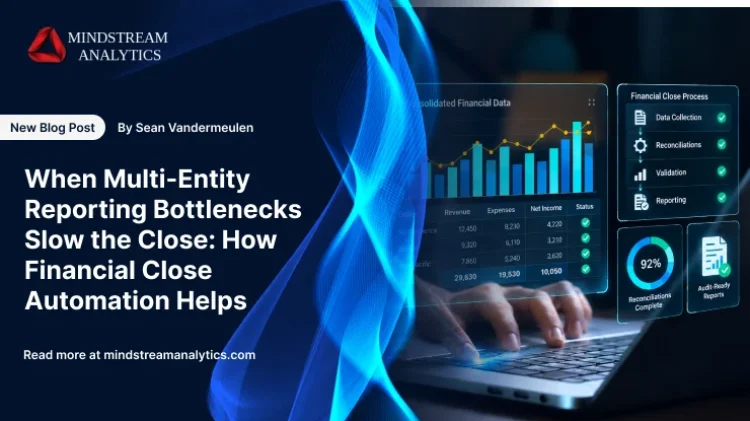
Finance leaders review regional reporting, reconciliation status, and consolidated financial data on a financial close automation dashboard.
Why does financial close become harder in multi-entity organizations?
Multi-entity organizations often use different systems, account structures, data formats, and reporting timelines across entities. These differences increase reconciliation, validation, mapping, and coordination requirements, making consolidated reporting more time-consuming and difficult to standardize.
Angela’s company had expanded its distribution network across several regions, adding legal entities, business units, and transaction volumes. Each entity relied on systems and procedures suited to its local operations. However, account structures, reporting timelines, and data formats varied, making financial close automation difficult to implement consistently across corporate reporting.
Much of the financial close process relied on spreadsheets, email exchanges, and manual data transfers. Regional teams submitted information in different formats, while corporate finance aligned account mappings, followed up on missing details, and worked through reporting dependencies before consolidated figures could be reviewed. When one submission changed, teams sometimes had to revisit information that had already been checked.
The fragmented process also consumed finance capacity. Controllers had to resolve outstanding reconciliation items within the close calendar, while Angela’s team spent time tracking submissions, clarifying differences, and responding to recurring status checks. For the CFO, delays in consolidated reporting meant less timely access to consistent information for performance reviews and business decisions.
For Angela, these impacts could be evaluated through measures such as close-cycle duration, analyst hours diverted to consolidation support, reconciliation and rework effort, unresolved-item follow-ups, approval delays, recurring status checks, and time available for analysis. Tracking these measures could help the organization assess whether changes to the financial close process were reducing operational friction and creating more capacity for higher-value finance work.
The Executive Review That Exposed the Reporting Bottleneck

During a quarterly review, a senior executive asks to explain a significant operating expense variance between two regions, reporting challenges that can be streamlined with financial close automation.
Angela had already improved the financial close process by standardising spreadsheet templates, tightening submission deadlines, and adding review checkpoints. These measures improved coordination but did not address the disconnected systems, inconsistent mappings, and manual reconciliations driving the workload. Angela realised that better process discipline could not compensate for structural problems that required financial close automation.
The limits of this approach became visible during a quarterly executive review. Preliminary consolidated results were available, but some supporting details were still being validated by the accounting teams. When a senior executive asked Angela to explain a significant operating expense variance between two regions, she needed to establish what was driving the difference before leadership could assess the regional results with confidence.
The discussion moved on, but Angela was left with a problem that went beyond one unanswered question. Her team had the analytical expertise to explain regional performance, yet fragmented reporting meant that assembling and validating the supporting evidence took priority over interpreting the results. Until those details were verified, leadership could see the variance but could not fully understand what was driving it.
The incident showed Angela that tighter deadlines and additional review checkpoints could not solve the underlying problem. Leadership needed explanations grounded in verified financial data, but disconnected systems and manual workflows made that information difficult to assemble when required.
Angela needed financial close automation that connected data, standardised workflows, and improved visibility across entities so her team could spend less time reconstructing the evidence and more time explaining business performance.
Connecting Data and Workflows Across the Financial Close Process

AI-powered financial dashboards illustrate how financial close automation can connect data, streamline reporting workflows, and support rapid prototyping.
How can financial close automation help multi-entity finance teams?
Financial close automation can connect financial data, standardize mappings and workflows, automate repeatable close activities, improve visibility across entities, and reduce manual coordination while preserving finance teams’ ownership of reconciliations, approvals, controls, and review.
After the review, Angela raised the recurring reporting delays with the CFO and Controller. They agreed that another reporting layer on top of disconnected processes would not address the root causes, and that close automation needed to address the underlying data and workflow gaps. Instead, they decided to explore a broader finance transformation focused on connecting financial data, standardizing workflows, and improving visibility across the close.
Angela was asked to evaluate OneStream and identify an implementation partner with both platform expertise and an understanding of finance operations. During the evaluation, she found MindStream Analytics and explored how its business-led transformation approach, OneStream capabilities, and AI-powered services could support the company’s requirements.
This distinction mattered to Angela. Controllers and regional accounting teams would continue to own transaction-level reconciliations, account validation, and accounting controls. Her FP&A team would remain focused on consolidated reporting, variance analysis, and planning. The transformation needed to improve coordination between these responsibilities without shifting accountability away from the teams closest to the work.
Connecting Data and Standardizing Workflows With OneStream
MindStream Analytics implemented OneStream as the technology foundation for financial close automation, configuring the platform around the company’s consolidation, reporting, and governance requirements. The implementation focused on integrating financial data from ERP and operational systems, standardising data structures and mappings across entities, and configuring workflows for financial submissions, validation, intercompany processing, account reconciliation, and consolidation.
By aligning these capabilities with the company’s finance processes and control requirements, MindStream addressed the operational causes of reporting delays rather than simply digitising existing manual steps.
Standardized mappings and hierarchies helped align reporting structures across entities. Configured workflows supported financial submissions, validation, intercompany processing, account reconciliation, and consolidation. Governance requirements, approval steps, and traceability were incorporated into the financial close process to help finance teams understand how reported figures were prepared, reviewed, and approved.
Can automation reduce manual work without removing financial controls?
Automation can reduce repetitive data handling, reconciliation, and workflow tasks while preserving financial controls through validation rules, approvals, audit trails, and finance-led review. This allows teams to improve efficiency without removing accountability for accuracy, compliance, or final decisions.
The objective was not to replace finance professionals’ judgment or remove essential reviews. Rather, financial close automation could reduce repetitive handling and help teams focus on exceptions, discrepancies, and decisions that required investigation. For Angela, the value lay in making information easier to follow across the organization while retaining the controls needed for reliable reporting.
Using AI-Powered Discovery and Rapid Prototyping
What role can AI play in financial close automation?
AI can support financial close automation by analyzing financial data, mapping requirements, identifying workflow patterns, preparing documentation, and accelerating testing and prototyping. It can reduce repetitive work while keeping finance teams responsible for validation, controls, approvals, and final decisions.
To support solution design, MindStream Analytics used AI agents to analyze existing spreadsheets, reporting templates, process documentation, mappings, and requirements. These inputs helped the team understand current workflows and translate business needs into proposed dashboards, reports, and processes to support financial close automation.
Once Angela, the Controllers, and regional stakeholders could experience their processes in the working application, the discussion changed. They could identify which reconciliations were unnecessarily manual, where mappings created repeated work, which controls needed to remain, and which reporting workflows could be simplified. MindStream then applied finance best practices, OneStream capabilities, automation, governance, controls, and the team’s business decisions to determine what the next version should improve.
AI agents then helped accelerate the work required to rebuild the application around those validated decisions. MindStream curated the outputs and remained accountable for solution design, architecture, controls, and implementation quality. AI accelerated the movement from one working version to the next; it did not make the business or control decisions.
The prototype did not resolve every implementation challenge or replace accounting validation. Angela’s team reviewed the improved version, and new findings became inputs to the next iteration. The cycle repeated: experience the application, identify what should change, apply better processes and controls, rebuild, and review again. Instead of trying to perfect the future state entirely on paper, the team progressively shaped it through successive working versions.
Once the successive iterations produced an environment that met the agreed business, process, data, control, usability, and operating requirements, the solution moved through formal validation, deployment readiness, and go-live. The iterative process helped surface issues while changes were still being shaped rather than waiting until late in the implementation to discover them.
How Financial Close Automation Creates More Time for Analysis
Once the financial close automation solution was in operation, standardized submissions and automated workflows reduced manual data collection, repetitive handling, and consolidation delays. This is a fictional outcome used to demonstrate potential value; actual results depend on factors such as the existing finance environment, data quality, process complexity, and implementation scope.
The scenario is hypothetical, but similar challenges have appeared in MindStream’s OneStream work. At CoorsTek, financial consolidation and reporting were spread across four Hyperion applications, offline Excel processes, and different rollup structures across major entities. MindStream consolidated these processes into OneStream, reducing reliance on manual intervention and improving financial reporting efficiency.
When leadership next asked Angela to explain a regional variance, she could begin with governed financial information rather than reconstructing the evidence through another chain of emails. The more connected financial close process created greater capacity for forecasting and analysis while preserving the oversight required for reliable reporting.
Supporting Finance Transformation Beyond Go-Live

A finance leader shares consolidated financial results and automated close workflows with executives, illustrating how ongoing support helps sustain financial close automation as business needs evolve.
For Angela, the work also needed to support the finance team as reporting requirements, entity structures, and workflows evolved. That meant treating financial close automation as part of an ongoing finance modernization effort rather than as a one-time technology project.
MindStream’s AI-Driven Adaptive Implementation approach uses AI agents to make rapid application iteration practical. The team starts with the customer’s existing finance environment, creates a working version, and lets finance stakeholders experience it in practice.
Their feedback identifies what should change, while MindStream applies finance best practices, OneStream capabilities, automation, governance, and controls to rebuild the next version. This cycle continues toward the agreed future state, with MindStream remaining accountable for solution design, architecture, controls, and implementation quality.
MindStream Analytics’ AppCare Managed Services provide ongoing application management, enhancements, governance, and support after go-live. This gives the organization a way to adapt its finance environment as entities, workflows, and reporting requirements evolve, rather than treating the implementation as a one-time project.
Finance expertise remained central throughout the work, helping preserve accounting ownership, controls, and review responsibilities as the close process became more connected.
FAQs
1. How can I automate financial close without disrupting ongoing operations?
You can introduce financial close automation in phases, starting with an assessment of current workflows, data sources, and reporting requirements. Prioritizing critical processes, validating integrations, and involving finance teams throughout implementation can help minimize disruption and support a gradual transition.
2. Can I automate financial close without replacing my existing ERP systems?
You may be able to automate financial close while retaining existing ERP systems, provided they can integrate with the chosen solution. Assess system compatibility, data structures, and integration requirements to determine how financial information can be consolidated without a complete ERP replacement.
3. How can I maintain data accuracy and controls when automating the financial close process?
Standardized data mappings, validation rules, approval workflows, and audit trails can help support data accuracy and accountability. Regular reconciliations and defined governance procedures remain important. Automation should reduce repetitive work while preserving appropriate review and oversight.
4. How can I help my finance team adapt to automated workflows?
Involve finance team members in solution design, prototyping, testing, and validation so they can help shape how the financial close process will work in practice. Role-specific training, clear process documentation, and ongoing support can help users understand new workflows, build confidence in the system, and focus more time on analysis.
5. How long does it take to implement financial close automation?
Implementation timelines depend on the number of entities and data sources, existing systems, process requirements, and project scope. Approximately two months may be achievable for appropriately scoped engagements, compared with traditional four-to-six-month implementations. This is a target, not a guaranteed timeline.
Ready to Improve Financial Close Automation?
Identify the process, system, data, and workflow bottlenecks that may be limiting your finance team’s capacity and reporting efficiency.