
- Executive Summary
- What Happens When Finance Outgrows Its Processes and Systems?
- The MindStream OneStream Implementation Framework
- Prototype What Exists
- Use, Experience, and Identify Inefficiencies
- Rapid Rebuild Using AI Agents
- Continue to Use, Identify, and Improve
- Validate and Deploy
- Optimizing Your OneStream Environment
- OneStream Implementation Best Practices
- Common OneStream Implementation Mistakes
- OneStream Implementation Checklist
- Conclusion
- Frequently Asked Questions
What Should You Consider Before Starting a OneStream Implementation?
A successful OneStream implementation starts before configuration. Organizations need to understand their current finance processes, establish the business outcomes they need to achieve, and create a working starting point that stakeholders can experience and quickly improve through rapid iterations using AI.
What Happens After a OneStream Implementation?
Go-live marks the beginning of the next stage of financial modernization. Organizations can continue to improve their OneStream environment through optimization, application management, enhancements, governance, and AI-powered automation, extending its value as business priorities, reporting requirements, acquisitions, and planning needs evolve.
Financial modernization rarely fails because an organization lacks technology. It fails when a OneStream implementation carries inefficient processes, disconnected data, or unnecessary complexity into the new environment.
Rapidly rebuild the application to resolve the inefficiencies identified at each stage. The identify-and-rebuild cycle continues until a new desired state is reached, followed by formal validation and deployment.
What Happens When Finance Outgrows Its Processes and Systems?
Fragmented Data Delays the Decisions That Matter
Financial information spread across ERPs, legal entities, business units, and transactional systems forces teams to spend time collecting, reconciling, and validating data before they can report on it. Executives may receive historical information when they need timely insight into performance, risks, and variances.
Manual Processes Turn Growth Into More Work
Weak Controls Increase Financial and Compliance Exposure
A New Platform Can Inherit Old Problems
What makes a successful OneStream implementation?
At MindStream, a successful OneStream implementation starts with the finance problem, not configuration. It gives finance stakeholders a working prototype early enough to experience, challenge, and improve it. MindStream uses AI agents to rapidly prototype the existing environment, then guides stakeholders through successive iterations that introduce better processes, best practices, automation, and controls until the desired state is reached.
The MindStream OneStream Implementation Framework: An AI-Driven Iterative Approach
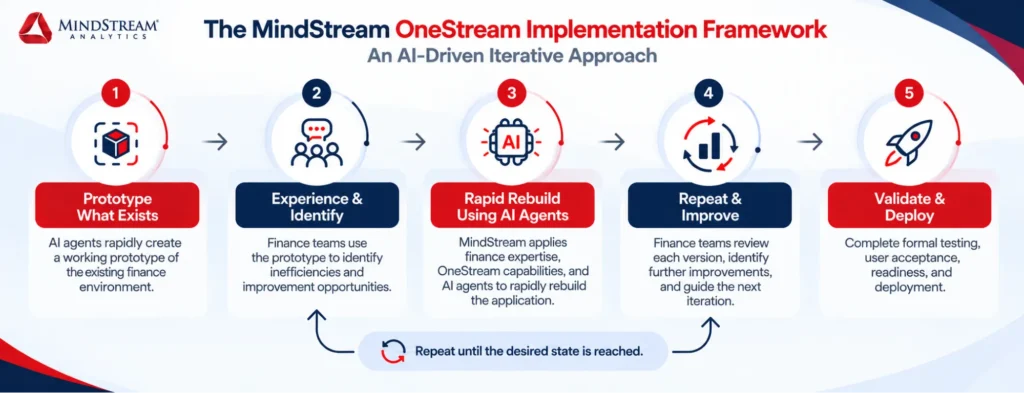
AI agents make this cycle practical by rapidly creating and rebuilding working versions of the application. MindStream curates and refines AI-generated outputs, applies finance and OneStream expertise, and guides each iteration, while client stakeholders validate the application and make the decisions that shape the next version.
Step 1: Prototype What Exists
Our OneStream implementation process starts with what the organization already has. We use AI agents to analyze the existing finance environment and rapidly create a working prototype from the customer’s processes, data, reports, templates, mappings, and requirements. The prototype provides the starting point for experiencing the application and identifying what should change.
How to implement
- Ingest Existing Finance Materials: Use AI agents to analyze spreadsheets, reports, process documentation, templates, mappings, requirements, and other available customer inputs.
- Create a Working Prototype: Translate the existing environment into a working representation that finance stakeholders can experience and evaluate.
- Establish the Starting Point: Capture the processes, data, workflows, and outputs represented in the prototype so the team has a clear basis for the first iteration.
- Prepare for Stakeholder Experience: Identify the finance scenarios and workflows stakeholders should use to evaluate the prototype and surface opportunities for improvement.
Step 2: Use, Experience, and Identify Inefficiencies
The prototype gives finance stakeholders something tangible to work with rather than asking them to define the complete future state upfront. Accounting, FP&A, and other relevant stakeholders interact with the working application and identify what is inefficient, unnecessarily complex, manual, unclear, or no longer fit for purpose.- Experience the Application: Let finance stakeholders work with the prototype using realistic finance processes, reports, workflows, planning activities, and reconciliations.
- Identify Inefficiencies: Surface manual work, unnecessary complexity, inefficient workflows, gaps, and processes that should change.
- Identify Improvement Opportunities: Determine where processes should be standardized, automated, integrated, redesigned, or retained.
- Prioritize the Next Changes: Agree on the improvements that should be incorporated into the next version of the application.
Step 3: Rapid Rebuild using AI agents
Once stakeholders identify what should change, MindStream applies finance transformation expertise, OneStream capabilities, and relevant best practices to determine how the application should improve.- Improve the Process: MindStream applies finance expertise, OneStream capabilities, and agreed best practices to determine how the identified inefficiencies should be addressed.
- Rebuild the Application: AI agents accelerate the work required to incorporate those changes and rapidly rebuild the application.
- Create the Next Version: The rebuilt application becomes the basis for another round of stakeholder usage and uncovering improvements.
Step 4: Continue to Use, Identify and Improve
The next version becomes the starting point for another round of stakeholder experience and improvement. Finance teams review the application, identify what should change next, and guide the next iteration. AI agents then rapidly rebuild the application based on those decisions.- Review the New Version: Let finance stakeholders experience the latest version of the application.
- Identify the Next Improvements: Determine what remains inefficient, unclear, overly complex, or inconsistent with the desired way of working.
- Rebuild With AI: Use MindStream’s AI agents to accelerate the changes required for the next version. The AI agents accelerate the rebuild of each working version.
- Repeat the Cycle: Continue the process until the desired new state is reached.
Step 5: Validate and Deploy
Once the desired new state is reached, MindStream completes formal testing, user acceptance, production readiness, and deployment. This marks the transition from iterative implementation to the live OneStream environment.What makes MindStream Analytics’ implementation approach different?
MindStream changes how OneStream implementation is delivered. Instead of trying to define and configure the complete future-state application upfront, MindStream starts by rapidly prototyping what exists today. Finance stakeholders experience the application, identify what should change, and work with MindStream to introduce better processes and practices. AI agents then rapidly rebuild the application based on that feedback. The cycle repeats until the desired new state is reached.
Extend the Value of Your OneStream Implementation Through Optimization and Managed Services
Optimize and Evolve the Finance Environment
- Refine Processes as Finance Evolves: Enhance close, consolidation, reporting, planning, forecasting, reconciliations, and related workflows as business priorities and finance requirements change.
- Extend OneStream Without Starting Over: Add reports, workflows, planning models, automation, and new finance use cases without treating every enhancement as a separate implementation project.
- Increase Automation Across Accounting and FP&A: Apply AI-powered automation to reduce repetitive work and create additional capacity for higher-value finance activities.
Sustain Value With Managed Services
Putting the Approach Into Practice
How Urban Grid Transformed Financial Planning and Reporting With OneStream Implementation

Planning, budgeting, and forecasting also moved into OneStream Software, reducing reliance on Excel. The result was a more connected and scalable finance environment with stronger reporting visibility and control.
What this demonstrates:
A successful OneStream implementation accounts for real finance complexity, including integration, ownership structures, planning, reporting, cash flow, and controls, rather than treating implementation as a software configuration exercise.
OneStream Implementation Best Practices
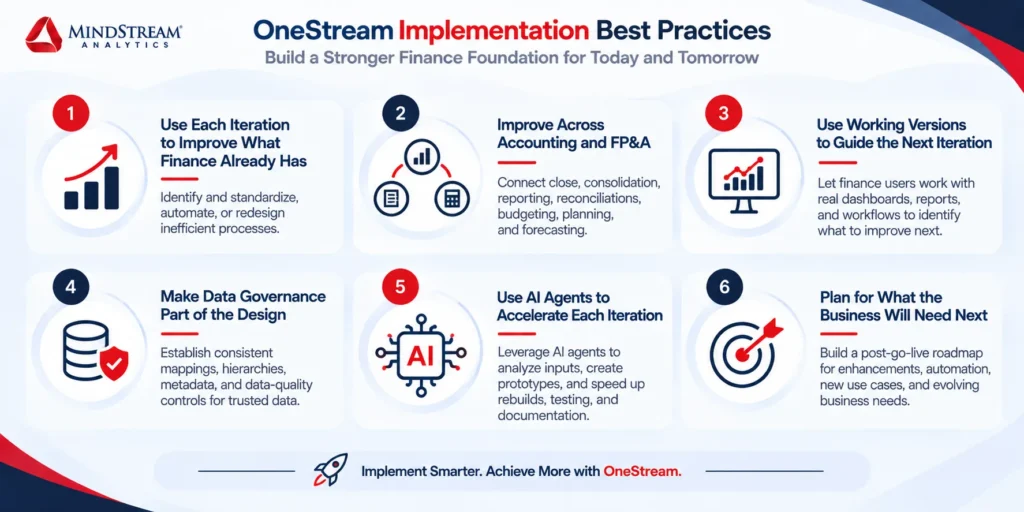
A successful OneStream implementation depends on a set of decisions that should guide the project from the initial prototype through post-go-live. These principles help finance leaders avoid rework, protect adoption, establish trusted data, and create an environment that can evolve with the business.1. Use Each Iteration to Improve What Finance Already Has
Let finance stakeholders experience the working application, identify inefficient processes, and determine what should be standardized, automated, integrated, or redesigned. Apply those decisions to the next version rather than trying to define every improvement upfront.
2. Improve the Application Across Accounting and FP&A
Use each iteration to connect close, consolidation, reporting, reconciliations, budgeting, planning, forecasting, and scenario modeling instead of creating another fragmented finance solution.
3. Use Working Versions to Guide the Next Iteration
Let finance users interact with working dashboards, reports, workflows, reconciliations, and planning models throughout implementation. Their experience should identify what needs to change in the next version of the application.
4. Make Data Governance Part of the Implementation Design
Establish consistent mappings, hierarchies, metadata, data-quality controls, and ownership early to create trusted financial information across the enterprise.
5. Use AI Agents to Accelerate Each Iteration
Use AI agents to rapidly analyze customer inputs, create working prototypes, and support the rebuilding, mappings, testing, and documentation required to move from one version of the application to the next.
6. Plan for What the Business Will Need After Go-Live
Build enhancements, automation, new reports, workflows, planning models, and additional use cases into the post-go-live roadmap as requirements evolve.

Common Mistakes to Avoid During OneStream Implementation
A OneStream implementation can lose momentum when organizations focus on configuration before resolving the underlying finance, data, and operating-model decisions. These mistakes often create rework, adoption challenges, or limitations after go-live.| Common Mistake | What It Can Cost You |
|---|---|
| Replicating inefficient legacy processes | Carries unnecessary complexity into the new environment and limits the value of modernization. |
| Treating the data model as an IT concern | Creates inconsistent information, weak governance, and problems that become harder to resolve later. |
| Building the Application Without Continuous User Interaction | Prevents finance teams from identifying inefficient processes while the application is still evolving and pushes important decisions into later stages when changes can create greater rework. |
| Using AI Without Making It Part of the Iteration Cycle | Adds another tool without changing how the application is built. AI should accelerate the creation and rebuilding of working versions so the team can move rapidly from one iteration to the next. |
| Planning only for deployment | Leaves the environment less prepared to adapt as business requirements change. |
The risks become clearer when you see what can happen when these principles are ignored.
What a Poor OneStream Implementation Can Look Like
How a Growing Manufacturer’s OneStream Implementation Fell Short
A growing manufacturer implemented OneStream to replace a fragmented finance environment spanning multiple ERPs, spreadsheets, and manual reporting processes. However, the project moved into configuration without giving finance stakeholders an effective way to experience working versions of the application and identify what should change.OneStream Implementation Checklist
Use this checklist to confirm that the key decisions, approvals, and transition activities are in place for a successful OneStream implementation.| Implementation Readiness Check | Done |
|---|---|
| Current-state processes, systems, data, and constraints documented | ✓ |
| Business outcomes, scope, priorities, and success measures agreed | ✓ |
| Initial working prototype created from the existing finance environment | ✓ |
| Prototype reviewed and experienced by finance stakeholders | ✓ |
| Improvement priorities identified and agreed | ✓ |
| Successive application iterations reviewed and refined | ✓ |
| OneStream requirements aligned across Accounting and FP&A | ✓ |
| Data model, mappings, hierarchies, and governance approach established | ✓ |
| Desired new state reached, validated, and tested | ✓ |
| User training, ownership, production readiness, and transition activities completed | ✓ |
Beyond Implementation: Maximize Your OneStream Investment With MindStream

A successful OneStream implementation should do more than replace fragmented finance processes. It should progressively improve how finance operates.
MindStream’s AI-Driven Adaptive Implementation methodology starts with what exists, rapidly creates a working prototype, and lets finance stakeholders experience it. The team identifies what should improve, introduces better processes and practices, and uses AI agents to rapidly rebuild the application. This cycle repeats until the desired new state is reached, followed by formal validation and deployment.
The result is an implementation shaped through working versions of the application rather than a solution defined entirely before users experience it.
The work does not stop at go-live. Through optimization, AppCare, and its Center of Excellence, MindStream helps organizations extend OneStream Software capabilities as finance requirements evolve.
Build on a successful OneStream implementation with continuous optimization that keeps your environment aligned with evolving finance needs.
How long will my OneStream implementation take?
The timeline depends on scope, finance complexity, data requirements, and organizational needs. Appropriately scoped OneStream implementation engagements can move faster when AI agents rapidly prototype the existing environment and accelerate the iterations required to reach the desired new state. The timeline should be established based on the organization’s current environment, scope, and implementation needs.
How much will my OneStream implementation cost?
There is no meaningful one-size-fits-all cost. Investment varies based on implementation scope, finance complexity, data requirements, integrations, and modernization objectives. Understanding the existing environment, scope, and priorities provides a stronger basis for determining the appropriate implementation effort and resources.
What do I need to have ready before starting a OneStream implementation?
The organization should have access to its current finance processes, source systems, data, governance requirements, organizational constraints, and desired outcomes. Not every requirement needs to be finalized upfront. MindStream uses these inputs to create an initial working prototype, which stakeholders can experience and use to identify what should change through successive iterations.