


Discover how financial automation helps finance teams use AI to reduce manual work, increase capacity, and modernize finance without adding headcount.

Executive Summary
What Is Financial Automation and Why Does It Matter?
Financial automation uses technology to automate repetitive financial tasks such as reconciliations, reporting, close, planning, and forecasting. AI can extend these capabilities by supporting analysis, anomaly detection, forecasting, reporting, and finance workflows. Together, these capabilities can reduce manual effort, increase finance capacity, improve accuracy, and help organizations scale without proportionally increasing headcount.
Adding headcount alone won’t fix a finance process that keeps creating more work.
As businesses grow, finance teams inherit more transactions, entities, systems, and reporting demands, often without the processes and technology needed to manage that complexity efficiently. The result is more time spent on spreadsheets, reconciliations, data collection, and manual workflows, leaving less capacity for analysis and strategic decision-making.
This guide shows finance leaders how to identify the right opportunities for automation, determine when to automate versus hire, prepare their data and processes for AI, and apply the MindStream Finance Capacity Framework to support finance transformation without adding unnecessary complexity or headcount.
Why Finance Modernization Matters: When Finance Complexity Outgrows Your Systems
As businesses grow, finance often inherits more entities, systems, transactions, and reporting requirements without the infrastructure to manage them efficiently. For CFOs, that can turn growth into more manual work, slower decisions, and pressure to expand the finance team.
Deloitte’s 2026 CFO Signals research found that 50% of CFOs rank digital transformation of finance as their top priority, while 49% prioritize automation that frees employees for higher-value work. For organizations facing growing complexity, financial automation is an important component of broader finance transformation.

Financial automation can streamline close, reconciliations, reporting, budgeting, and forecasting while giving finance teams more capacity for analysis.
The Growing Complexity of Enterprise Finance
Finance rarely runs from one system or one standardized process as an organization expands. Acquisitions, new markets, multiple business units, and legacy technology can create layers of complexity that make routine finance activities increasingly difficult to manage.
Common sources of finance complexity include:
- Multiple legal entities requiring separate reporting, consolidation, and intercompany processes
- Multiple ERP systems containing financial and operational data across the organization
- Different business-unit processes creating inconsistent workflows and reporting structures
- Geographic expansion adding currencies, regulations, and reporting requirements
- Acquisitions introducing new entities, systems, employees, and historical data
- Higher transaction volumes increasing pressure on manual finance processes
- Greater reporting demands requiring faster access to accurate financial information
- Stronger governance requirements increasing the need for consistent controls and traceability
The result: Finance teams spend more time collecting, reconciling, validating, and maintaining information and less time on analysis, planning, and strategic decision-making.
The Traditional Response: Add More People
When finance workload rises, hiring can seem like the quickest way to increase capacity. But adding employees does not remove the underlying friction when teams are still dependent on spreadsheets, disconnected applications, and manual workflows.
The cycle often looks like:
More business complexity → more manual work → more finance workload → more headcount
Additional headcount still leaves teams dealing with:
- Fragmented financial data across multiple systems
- Duplicate data entry and repetitive processes
- Spreadsheet-heavy reporting and planning
- Manual account reconciliations and transaction matching
- Disconnected applications and workflows
- Inconsistent processes across entities and business units
The problem is not always a shortage of people. Sometimes, the finance operating model is creating work that technology and better processes could eliminate.
The Modern Response: Increase Finance Capacity Through Financial Automation
Instead of scaling finance primarily through headcount, organizations can increase capacity by standardizing processes, connecting financial data, and automating repetitive work. Deloitte reports that 53% of CFOs identify automation or technology upgrades as the most effective non-workforce lever for controlling costs.
A modern finance transformation approach focuses on using automation to:
- Automate repetitive, rules-based finance activities
- Standardize processes across entities and business units
- Connect financial data across systems
- Reduce manual reconciliation and consolidation work
- Give teams faster access to trusted financial information
- Shift finance professionals toward analysis, forecasting, and decision support
The goal of financial automation isn’t simply to reduce manual tasks. It is to give lean finance teams the capacity to handle greater business complexity without continuously increasing administrative workload.
The next step is to understand exactly which finance processes can be automated and where automation can create the most value.
See the Hidden Costs of Manual Finance
What Can Financial Automation Actually Automate?
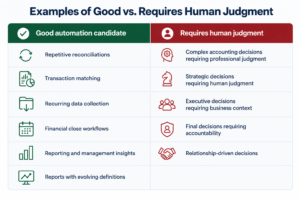
Financial automation can automate repetitive, rules-based work such as financial close, reconciliations, transaction matching, reporting, budgeting, forecasting, and recurring data collection. It is best suited to processes with defined rules, consistent data, and predictable workflows.
How AI Extends Financial Automation
AI extends financial automation by helping lean finance teams increase capacity and do more with the team they already have. In finance transformation, AI can support:
- Financial Analysis: Surface patterns, trends, and insights from financial data faster.
- Anomaly Detection: Flag unusual transactions and unexpected financial variances for review.
- Forecasting: Support faster forecasts, scenario analysis, and planning decisions.
- Management Reporting: Turn financial data into concise, decision-ready insights.
- Finance Workflows: Accelerate reporting, reconciliation, and other repetitive finance activities.
The goal is not to add AI for its own sake, but to use it where it extends finance capacity while keeping finance professionals focused on judgment, analysis, and decision-making.
AI can create additional capacity, but realizing that value requires a structured approach to financial automation. The following framework provides a practical path from assessment through implementation and continuous optimization.
See What CFOs Should Automate First
When Should You Automate vs. Hire?
Automate work that is repetitive, rules-based, predictable, and high-volume. Hire when additional capacity requires specialized expertise, strategic judgment, or sustained human ownership. The goal is not to replace finance talent, but to use automation to reduce repetitive workload and redirect finance capacity toward analysis, decision-making, and higher-value work.
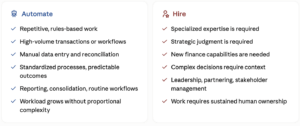
Use financial automation for repetitive, predictable work while reserving finance talent for specialized expertise, judgment, and strategic decisions.
Find Out If You Need More Finance Staff
The MindStream Finance Capacity Framework: A Practical Approach to Financial Automation
Financial automation delivers the greatest value when technology is applied to the way finance actually operates. The MindStream Finance Capacity Framework takes an AI-powered, iterative approach to finance transformation, rapidly assessing the existing environment, prototyping solutions, validating them with users, accelerating implementation, and continuously evolving the finance operation.
The framework moves finance through five stages:
Rapidly Assess → Rapidly Prototype → Validate & Refine → Accelerate Implementation → Continuously Evolve
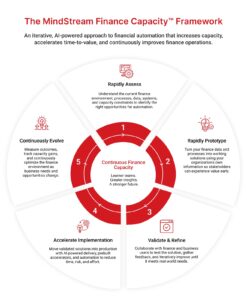
The MindStream Finance Capacity Framework for financial automation.
- Rapidly Assess: Use AI-assisted analysis and finance expertise to understand existing processes, systems, data, and capacity constraints.
- Rapidly Prototype: Turn the organization’s existing finance information into working prototypes that allow stakeholders to experience potential solutions early.
- Validate & Refine: Collaborate with finance and business stakeholders to test workflows, identify gaps, and iteratively improve the solution.
- Accelerate Implementation: Move validated solutions into production while using AI agents to accelerate configuration, mappings, testing, documentation, and deployment activities.
- Continuously Evolve: Extend and optimize the finance environment through ongoing enhancements, AI-powered automation, and new capabilities as business needs change.
The goal is not simply to automate more tasks. It is to create a finance environment that can adapt to increasing complexity, accelerate time-to-value, and give finance professionals greater capacity for analysis, planning, and strategic decision-making.
Step 1: Assess the Finance Environment
What it is: Quickly establish how finance currently operates, using AI-assisted analysis and finance expertise to identify process dependencies, data challenges, system complexity, and areas where manual effort is limiting capacity.
How to implement:
- Analyze Existing Finance Materials: Use AI agents to examine spreadsheets, reports, process documentation, templates, mappings, and other existing finance materials.
- Identify Process and Data Constraints: Determine where disconnected systems, fragmented data, manual workflows, and inconsistent processes create friction or limit visibility.
- Prioritize Transformation Opportunities: Identify the finance activities where technology and process improvements can deliver meaningful gains in capacity, efficiency, control, or decision-making.
Pro tip: Use the information the organization already has to accelerate discovery rather than spending months documenting the current state from scratch.
Step 2: Rapidly Prototype the Future-State Solution
What it is: Convert the insights gathered during discovery into working representations of the future finance environment, allowing stakeholders to experience potential solutions before committing to full implementation.
How to implement:
- Build Working Prototypes: Use AI agents to rapidly create dashboards, reports, planning models, reconciliations, workflows, and other finance applications.
- Use the Organization’s Own Information: Develop prototypes using relevant customer data, processes, structures, and existing finance materials rather than relying on generic demonstrations.
- Demonstrate the Future State Early: Give stakeholders a tangible view of how the proposed solution could operate before the implementation is fully configured.
Pro tip: Show stakeholders a working solution early. Seeing and interacting with the future state creates a stronger foundation for refinement than reviewing requirements and designs in isolation.

AI extends financial automation by helping finance teams analyze data, detect anomalies, improve forecasts, and accelerate reporting.
Step 3: Validate and Refine Through Collaboration
What it is: Use direct interaction with working prototypes to validate the solution, uncover gaps, and continuously improve workflows and functionality with the people who will use them.
How to implement:
- Engage Key Stakeholders: Bring Accounting, FP&A, reporting, and business stakeholders into the process early.
- Validate Real-World Workflows: Have users interact with dashboards, reports, planning models, reconciliations, and workflows to confirm that they support actual finance requirements.
- Iterate Based on Feedback: Incorporate stakeholder feedback into the prototype, refining processes and functionality as the solution takes shape.
Pro tip: Treat user feedback as part of solution development, not a final testing exercise. Early interaction can reveal gaps while they are still fast and inexpensive to address.
Step 4: Accelerate Implementation With AI

Financial automation becomes scalable when financial data, systems, reporting, planning, and workflows are connected through a structured operating environment.
What it is: Move the validated solution into production using AI-powered delivery capabilities to accelerate the technical and operational activities required for implementation.
How to implement:
- Accelerate Configuration: Use AI agents to support configuration activities and translate validated workflows into the implementation environment.
- Automate Delivery Activities: Apply AI across mappings, testing, documentation, deployment preparation, training development, and validation.
- Move From Proven Prototype to Production: Implement the solution after key workflows and requirements have been validated, reducing uncertainty and unnecessary rework during deployment.
Pro tip: Use implementation effort where it creates value rather than repeatedly recreating work that AI can accelerate. A validated prototype provides a clearer foundation for production delivery.
Step 5: Continuously Evolve the Finance Environment
What it is: Treat implementation as the beginning of an ongoing finance transformation rather than the end of a project, continuously adapting the environment as business needs, reporting requirements, and technology evolve.
How to implement:
- Extend Existing Capabilities: Add new reports, workflows, planning models, automations, and other capabilities as finance requirements change.
- Leverage AI-Powered Innovation: Identify new opportunities to apply AI and automation across the finance environment without requiring a new transformation project for every enhancement.
- Optimize Through AppCare and Ongoing Support: Continuously improve application performance, governance, and functionality while maximizing the long-term value of the finance transformation investment.
Pro tip: Don’t treat go-live as the finish line. Build the finance environment to evolve continuously as the organization, its data, and its priorities change.
Putting The MindStream Finance Capacity Framework Into Practice
The MindStream Finance Capacity Framework gives finance leaders a practical, AI-powered approach to modernizing finance—from rapidly assessing the current environment and prototyping solutions to validating, implementing, and continuously improving the future-state finance operation.
By following Rapidly Assess → Rapidly Prototype → Validate & Refine → Accelerate Implementation → Continuously Evolve, finance teams can increase capacity, improve decision-making, accelerate time-to-value, and continuously adapt their finance environment as business needs evolve.
How Finance Automation Helps Lean Teams Scale Without Adding Headcount

Financial automation gives lean finance teams more capacity for analysis and decision-making without increasing administrative workload at the same rate.
As finance teams grow more complex, adding people isn’t always the best way to increase capacity. Finance transformation can address the underlying process, data, and workflow constraints so teams can handle greater volume while giving finance professionals more time for analysis and decision-making.
Bad Example: Scaling Finance by Adding More Manual Work
A growing company continues relying on Excel for capital planning, consolidation, reporting, and forecasting as its entities, transactions, and projects increase.
Why it fails:
- More business activity creates more spreadsheets and manual updates.
- Finance spends more time collecting and reconciling data.
- Reporting and planning take longer as complexity increases.
- Adding headcount increases capacity temporarily without fixing the underlying process.
The better approach is to modernize the underlying finance processes and systems so the organization can handle greater complexity without creating the same amount of additional manual work.
Good Example: Replacing Spreadsheet-Driven Capital Planning With a Scalable Finance Process
When we began working with Alterra Mountain Company, a diversified organization spanning recreation, hospitality, real estate, food and beverage, and retail, we found capital planning still heavily dependent on offline Excel spreadsheets. Updated actuals were difficult to incorporate, while project budgets lacked a centralized view across thousands of projects.
We focused on the core issues:
- Manual planning: Capital planning relied heavily on disconnected spreadsheets.
- Data integration: Updated actuals were difficult to incorporate efficiently.
- Project visibility: Budget and spend information was fragmented across thousands of projects.
We implemented OneStream with NetSuite integration to eliminate manual data entry and dashboards to track more than 3,000 projects across multiple years. The result was better budget and spend visibility, more timely reporting, reduced spreadsheet dependence, and a scalable planning foundation leadership chose to expand across the organization.
Good Example: Replacing Excel-Based Consolidation With Scalable Renewable Energy Finance
When we began working with Urban Grid Holdings LLC, a utility-scale renewable energy developer, its finance environment had become difficult to manage as the business expanded. NetSuite had recently been implemented, consolidations still depended on Excel, ownership structures were complex, and detailed cash flow and SOX reporting requirements demanded stronger controls and visibility.
We focused on the core issues:
- Manual consolidation: Quarter-end consolidation was performed in Excel, increasing inefficiency and error risk.
- Ownership complexity: Changing project and entity structures required more sophisticated consolidation logic.
- Limited visibility: Complex cash flows and financial data made timely analysis difficult.
We implemented OneStream with NetSuite integration, period-based ownership structures, automated cash flow reporting, and custom dashboards. Urban Grid can now manage planning, budgeting, forecasting, and close reporting within OneStream while reducing Excel dependence and gaining more granular financial visibility.
Across these MindStream client engagements, the common pattern is clear: redesign the process, unify the data, implement the right automation, and measure the resulting business outcomes.
Learn How Lean Finance Teams Scale
10 Pro Tips for Getting More From Financial Automation
The strongest financial automation programs redesign finance processes, establish a governed, unified source of financial truth, and measure business outcomes rather than simply automating manual tasks.
1. Measure the Full Process Before Automating
Pro Tip: Assess manual effort, volume, risk, business impact, and readiness, not just hours spent.
2. Trace Critical Spreadsheet Dependencies
Pro Tip: Map spreadsheet inputs, calculations, owners, and downstream dependencies before replacing them.
3. Automate Rules and Route Exceptions
Automate repeatable workflows while routing judgment-based exceptions to the appropriate finance owners.
4. Standardize Financial Data Structures First
Align entities, accounts, mappings, hierarchies, definitions, and ownership before scaling financial automation.
5. Design the Future State Before Selecting Technology
Decide what to standardize, automate, integrate, govern, or redesign before configuring the solution.
6. Start With a Measurable Automation Opportunity
Choose a process where the baseline, expected improvement, and business value can be clearly measured.
7. Prototype With Finance Users Early
Validate dashboards, reports, planning models, reconciliations, and workflows before implementation is finalized.
8. Build Controls Into the Workflow
Embed approvals, validation rules, audit trails, access controls, and exception handling from the outset.
9. Solve the Finance Problem Before Applying AI
Define the finance problem first, then apply AI where it can strengthen analysis, anomaly detection, forecasting, reporting, or workflow execution.
10. Measure Capacity Recovered and Time-to-Value
Track manual effort, cycle time, accuracy, adoption, capacity gains, and how quickly business value is realized.
These tactics turn financial automation from a technology initiative into a measurable capacity strategy, helping finance teams recover time, strengthen processes, and create more room for higher-value work.
8 Common Financial Automation Mistakes That Limit ROI
Financial automation can create significant capacity gains, but poor process design, fragmented data, and weak governance can undermine the investment. Avoiding these mistakes helps finance leaders achieve faster time-to-value and build automation that scales.
Before expanding your financial automation roadmap, make sure you aren’t reinforcing the problems you’re trying to eliminate.
| Common Mistake | What You Should Do |
|---|---|
| Automating manual data assembly | Redesign data integration workflows first; eliminate manual collection, copy-pasting, and repetitive rework before adding automation tools. |
| Rushing close processes with flawed reporting | Optimize and standardize monthly close cycles to ensure faster reporting and timely, data-driven decision-making. |
| Applying tech to isolated budgeting and forecasting | Connect planning and forecasting systems across all business units before scaling automation to shorten planning cycles. |
| Accepting disconnected systems as normal | Establish unified data definitions and connected architectures to ensure end-to-end visibility, auditability, and strong financial control. |
| Scaling fragmented processes during growth | Streamline and standardize core finance workflows before expanding so operating costs stay lean as the business grows. |
The best financial automation programs don’t simply automate more work; they remove unnecessary work, strengthen controls, and increase finance capacity.
Learn More on Why Finance Modernization Fails
Financial Automation Readiness Checklist: 10 Things to Assess Before You Automate
The checklist should not imply that everything needs to be perfectly prepared before automation begins. Instead, it should establish whether the organization has the information, processes, stakeholders, and controls needed to begin an AI-assisted, prototype-driven transformation.
| Checklist Item | What to Check |
|---|---|
| Identify the Existing Finance Process | Determine how the process operates today, whether it relies on Excel, ERP workflows, manual processes, or other applications. |
| Gather Existing Finance Materials | Bring together relevant spreadsheets, reports, templates, mappings, documentation, and other materials that describe or support the current process. |
| Identify the Process Objective | Establish what the finance team needs the process to accomplish, including reporting, planning, reconciliation, consolidation, analysis, or other business outcomes. |
| Identify Key Data Sources | Understand where the information required by the process originates and how it currently moves through the finance environment. |
| Build the Initial Prototype | Determine whether the existing process and information can be translated into a working OneStream prototype that stakeholders can interact with and evaluate. |
| Engage Finance Users Early | Involve Accounting, FP&A, reporting, and business stakeholders who can evaluate the prototype against actual finance requirements and workflows. |
| Iterate Through Successive Prototypes | Use stakeholder feedback and observed process requirements to adjust the workflow, data structures, functionality, and outputs through successive prototypes. |
| Build Governance Into the Solution | Incorporate appropriate controls, approvals, validation rules, audit trails, access controls, and traceability as the solution is refined toward its final state. |
| Validate the Final Finance Process | Confirm that the resulting OneStream solution produces the required outputs, supports the intended workflow, and provides the governance and auditability required by the organization. |
| Measure Business Value | Compare the resulting process against the original environment using measures such as manual effort, cycle time, reporting speed, accuracy, capacity recovered, adoption, and time-to-value. |
A strong automation readiness assessment does not require finance teams to perfect their processes before transformation begins. Instead, it establishes the existing process, data, and business objectives needed to rapidly create an initial prototype. From there, finance users can interact with the solution, refine the process through successive prototypes, and develop a final OneStream environment that delivers the required functionality, governance, and auditability.
Scale Finance Capacity, Not Finance Complexity
Financial automation is not about replacing finance teams or adding technology for its own sake. It is about removing unnecessary manual work, connecting financial data, and giving finance teams more capacity to focus on analysis, planning, and strategic decision-making.
The MindStream Finance Capacity Framework gives finance leaders a practical path to finance transformation: identify capacity constraints, design the future-state finance operation, prioritize automation opportunities, launch the right solutions, and prove and improve business outcomes over time.
With the right processes, data, technology, and governance in place, finance teams can increase capacity, improve visibility, and support business growth without scaling administrative complexity at the same rate. That is the foundation for sustainable finance transformation.
Frequently Asked Questions
1. Will financial automation eliminate finance jobs?
Not necessarily. Financial automation reduces repetitive processing and increases finance capacity, allowing teams to spend more time on analysis, planning, forecasting, controls, and strategic decision-making rather than manual data work.
2. How do I know if a finance process is ready for automation?
Look for processes that are repetitive, rules-based, high-volume, and supported by consistent data. Also assess process stability, exceptions, system dependencies, manual effort, risk, and business impact before implementing financial automation.
3. Can financial automation work if my financial data is spread across multiple ERPs?
Yes, but connecting systems alone is not enough. Consistent financial definitions, mappings, hierarchies, and governance are needed to turn data from multiple ERPs into reliable consolidated reporting, planning, and analysis.
4. Will financial automation increase financial reporting or compliance risk?
Not when appropriate controls are built into the process. Approvals, validation rules, access controls, audit trails, exception handling, and human oversight can help strengthen governance, accuracy, and traceability across automated finance workflows.
5. How do I measure the ROI of financial automation?
Establish a baseline before implementation and compare it with post-implementation results. Track manual effort, process cycle time, close duration, reporting speed, reconciliation effort, accuracy, adoption, capacity recovered, implementation costs, and time-to-value.
6. What is the difference between financial automation and finance transformation?
Financial automation focuses on using technology to reduce manual work and improve specific processes. Finance transformation is broader, encompassing processes, data, systems, governance, operating models, and the capabilities finance needs to support the business as it grows.
Research & References
https://www.deloitte.com/us/en/about/press-room/deloitte-q4-2025-cfo-signals-survey.html
https://www.urbangridsolar.com/


Comments 04
Finance Automation | CFO Guide to Smarter AI Adoption
October 06, 2026[…] identify the right AI opportunities, automate core Accounting processes, improve reporting, extend finance automation into financial planning automation and FP&A automation, and scale these capabilities through […]
Use Finance Automation to Scale Without Adding Headcount
October 06, 2026[…] finance automation alone isn’t enough. Finance leaders need finance process improvement to simplify and […]
5 Costly Financial Data Management Mistakes Draining Finance Teams
October 08, 2026[…] repeatedly extracted, reconciled, or re-entered across teams and systems. Repeated handling signals automation potential, and the more it happens, the greater the opportunity to strengthen financial data management and […]
Finance Modernization Risks for Financial Planning & Analysis
October 13, 2026[…] solution then automated repetitive activities across reporting, consolidation, reconciliations, planning, and forecasting, reducing the […]