


Oracle EPM Standard vs Enterprise: Key Differences
Oracle EPM Standard vs Enterprise compares two Cloud EPM editions designed for different levels of process complexity, scale, and transformation.
Oracle Enterprise Performance Management (EPM) Cloud services ensure a connected and agile experience across multiple business processes. The business processes and features available depend on the specific EPM Cloud service that you purchase.
Below is an overview of the business processes available in each solution:
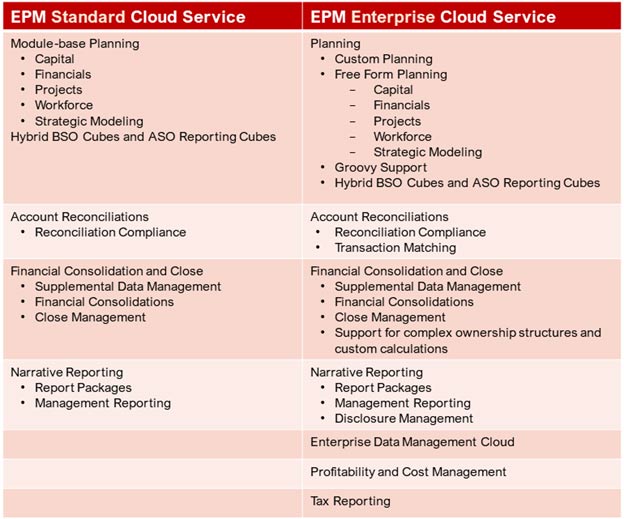
EPM Standard Cloud Service is a suite of business processes designed primarily for small to mid-sized businesses and those with lower complexity requirements to support planning and budgeting, consolidation and close, account reconciliation, and narrative reporting processes.
Data Management, which enables you to integrate data from source systems, and command-line tools, such as Oracle Smart View for Office and EPM Automate, are also included.
In the EPM Standard Cloud, you can deploy one of the following business processes:
- Planning
- Account Reconciliation
- Financial Consolidation and Close
- Narrative Reporting
The EPM Enterprise Cloud Service comprises the full suite of Oracle Enterprise Performance Management Cloud business processes supporting activities spanning across planning and budgeting, consolidation and close, account reconciliation, profitability and cost management, tax reporting, enterprise data management, and narrative reporting.
Oracle Cloud Planning – Custom Planning, module-based Planning, and Free Form planning is supported to deliver instant value and greater productivity for business planners, analysts, and decision-makers across all lines of business.
Custom Planning enables a streamlined process-driven custom solution. Module-based Planning comes bundled with pre-packaged Capital, Financials, Projects, Strategic Modeling, and Workforce modules.
Free Form Planning helps you to create an unrestricted free form dimension solution using an Essbase outline file. Additionally, EPM Enterprise Cloud Service supports the use of the Groovy scripting language to customize business rules in the Planning business process.
Account Reconciliation – This business process with transaction matching support is used to automate the process of validating your company’s financial accounts by checking the account balances for accuracy. Transaction matching helps automate the process of reconciling high volume or labor-intensive reconciliations and integrating results into the tracking features within reconciliation compliance.
Financial Consolidation and Close – This business process supports consolidation and close process tasks with default, prebuilt calculations. You can create custom calculations and complex ownership structures and automate consolidation and close tasks.
Financial Consolidation and Close comes bundled with Supplemental Data Manager and Close Manager modules, and also supports the integration of Close Manager with other services.
Narrative Reporting – Along with Disclosure Management, this business process provides a secure, process-driven approach for defining, authoring, reviewing, and publishing financial and management report packages.
Enterprise Data Management – this business process helps you manage business viewpoints, govern changes across them, share and map data sets to accelerate deployment, and build an authoritative system of reference.
Profitability and Cost Management – this business process helps you manage the cost and revenue allocations that are necessary to compute profitability for a business segment, such as a product, customer, region, or branch.
Tax Reporting – this business process calculates your company’s global tax provision, effective tax rate, and deferred tax for tax provisioning purposes following the standards for accounting for income taxes under GAAP and IFRS.
MindStream Analytics is a premier consulting and managed services provider. We help organizations acquire, implement, host, and manage strategic finance solutions designed to grow your business-including Oracle EPM Cloud Services- by bringing people, processes, and information together. Our team is made up of business and technical experts with years of experience with Enterprise Performance Management, Business Intelligence, and Advanced Analytics.
Fill out the form below to learn more about MindStream Analytics and Oracle standard vs enterprise cloud based EPM platform.
Oracle EPM Standard vs Enterprise capabilities compared
Oracle EPM Standard vs Enterprise provides the decision context. The Standard edition supports core planning and financial consolidation requirements for organizations seeking a streamlined cloud deployment. The Enterprise edition adds broader configuration, advanced business processes, greater scale, and capabilities for organizations replacing multiple legacy EPM applications.
When evaluating Oracle EPM Standard vs Enterprise, teams should consider application count, dimensional complexity, planning frameworks, consolidation needs, reporting, account reconciliation, enterprise data management, integrations, user volumes, and future growth rather than comparing subscription cost alone.
For Oracle EPM Standard vs Enterprise, MindStream helps document requirements, assess the current landscape, identify capability gaps, estimate migration effort, and build a phased roadmap. The right edition should support immediate priorities while providing an operating model that administrators and business owners can sustain.
Explore related MindStream services for Oracle EPM Cloud, Cloud EPM, enterprise planning, financial close, and Oracle services. For official information, visit Oracle Enterprise Performance Management.
Clear ownership, documented schedules, representative testing, and exception procedures keep recurring processes reliable. Role-based training and concise operational guidance help users complete work consistently and resolve common issues before deadlines are affected.
After launch, usage monitoring and governance reviews identify valuable capabilities, duplicated effort, and opportunities for automation. This discipline keeps the environment aligned with changing business priorities and directs investment toward measurable outcomes.
Oracle EPM Standard vs Enterprise should ultimately align capabilities, governance, cost, and long-term transformation goals.