


Oracle FreeForm Planning for Powerful Flexibility
Oracle FreeForm Planning gives organizations flexible multidimensional modeling for specialized planning, forecasting, scenario analysis, and reporting requirements.
Free form Planning is an application type within the Oracle EPM Cloud – Enterprise Edition. The benefits of this SaaS-based free form planning process are that it offers the flexibility of Essbase , has the ability to create cubes from Excel, enables robust web-based planning capabilities, and allows you to connect these free form and structured planning apps across the organization.
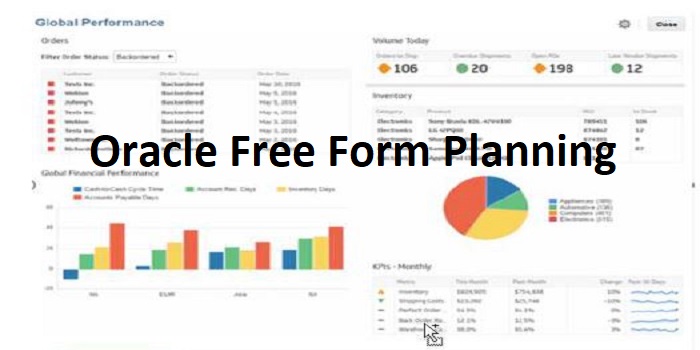
The following are the primary characteristics of the freeform planning application:
- Does not require all Planning specific dimensions
- The scale of the dimensions is large (~1 million)
- Leverages Essbase calculation engine
- Performs instantaneous roll-up
- The application can be created using Essbase OTL or empty cube
- Support UI features like Dashboards, Web forms, Valid Combinations, etc.
Oracle is no longer separating its cloud services for its Enterprise Performance Management (EPM) solutions. In an effort to address needs across financial and operational planning, consolidation and close, data management, internal and external reporting, and profitability management processes, they are now offering a complete, integrated solution available in two options: Oracle EPM Cloud – Standard Edition and Oracle EPM Cloud – Enterprise Edition.
An important characteristic of Oracle EPM Cloud is the application’s suite. When compared to deploying a single-point software application-such as consolidations or planning and budgeting-Oracle EPM Cloud offers an advantage. The complete solution integrates management processes across the organization, aligning strategy with execution. Users gain improved visibility and insight into all aspects of the business and it helps them leverage their investment through seamless data and process integration with their core ERP systems.
The cloud also offers a more affordable alternative for EPM that lowers both operational expenses (OpEx) and capital expenses (CapEx), because it eliminates the need for your organization to purchase software and hardware or hire additional IT staff. With no costly infrastructure to support, resources can be invested in growth opportunities, allowing users to focus on more value-added tasks instead of managing IT.
As an Oracle Gold and Oracle Cloud Partner, we help companies acquire, implement, host, and manage strategic finance solutions designed to grow your business by bringing people, processes, and information together. Our team is made up of business and technical experts with years of experience working with Oracle EPM solutions.
Want to know more about Oracle EPM? Fill out the form below and we’ll get back to you shortly.
How Oracle FreeForm Planning supports flexible models
Oracle FreeForm Planning enables teams to create custom planning applications without being limited to a predefined framework. Finance and operational groups can design dimensions, forms, calculations, dashboards, workflows, and reports around business processes that require greater modeling freedom.
The solution can support strategic, operational, project, sales, capital, workforce, and other specialized use cases. Smart View provides a familiar spreadsheet interface, while governed security, approvals, business rules, and centralized data help reduce the risks of disconnected planning files.
MindStream helps define requirements, design dimensions, build calculations, integrate source data, configure workflow and security, test performance, train users, and establish support procedures. A phased Oracle FreeForm Planning implementation can begin with a focused use case and expand as governance and adoption mature.
Explore related MindStream services for Enterprise Planning Cloud, Oracle EPBCS, Oracle EPM Cloud, strategic planning, and Oracle services. For official information, visit Oracle Cloud Planning.
Clear ownership, documented assumptions, representative testing, and release procedures keep flexible models maintainable. Teams should establish naming standards, calculation reviews, data-quality checks, and performance baselines before expanding an application to additional contributors.
After launch, usage monitoring and governance reviews identify valuable forms, duplicated rules, slow calculations, and opportunities for automation. Role-based training and concise documentation help users complete planning tasks consistently and resolve common issues before deadlines.
Oracle FreeForm Planning should remain aligned with measurable business outcomes and clear governance.